Can Veneers from Another Clinic Be Redone If You Dislike Their Shape or They Break, Fall Off, or Feel Uncomfortable?
After receiving veneers at another clinic, you may feel that the teeth look longer, thicker, or more angular than expected and do not blend with the surrounding teeth. In other cases, the shape may be satisfactory, but part of a veneer may chip or detach, or the bite may feel uncomfortable.
Veneers placed at another clinic can be evaluated for retreatment when there are concerns about their shape, chipping, detachment, or discomfort when biting. Whether the appropriate approach is adjustment, repair, rebonding, or replacement of some or all veneers depends on the cause of the problem and an examination of the existing restorations, remaining teeth, gums, and bite.
This guide explains how to describe the shape you want to change, how possible retreatment options differ, and what can be assessed before and after the existing veneers are removed.
If You Dislike the Shape of Your Veneers, First Identify What You Want to Change
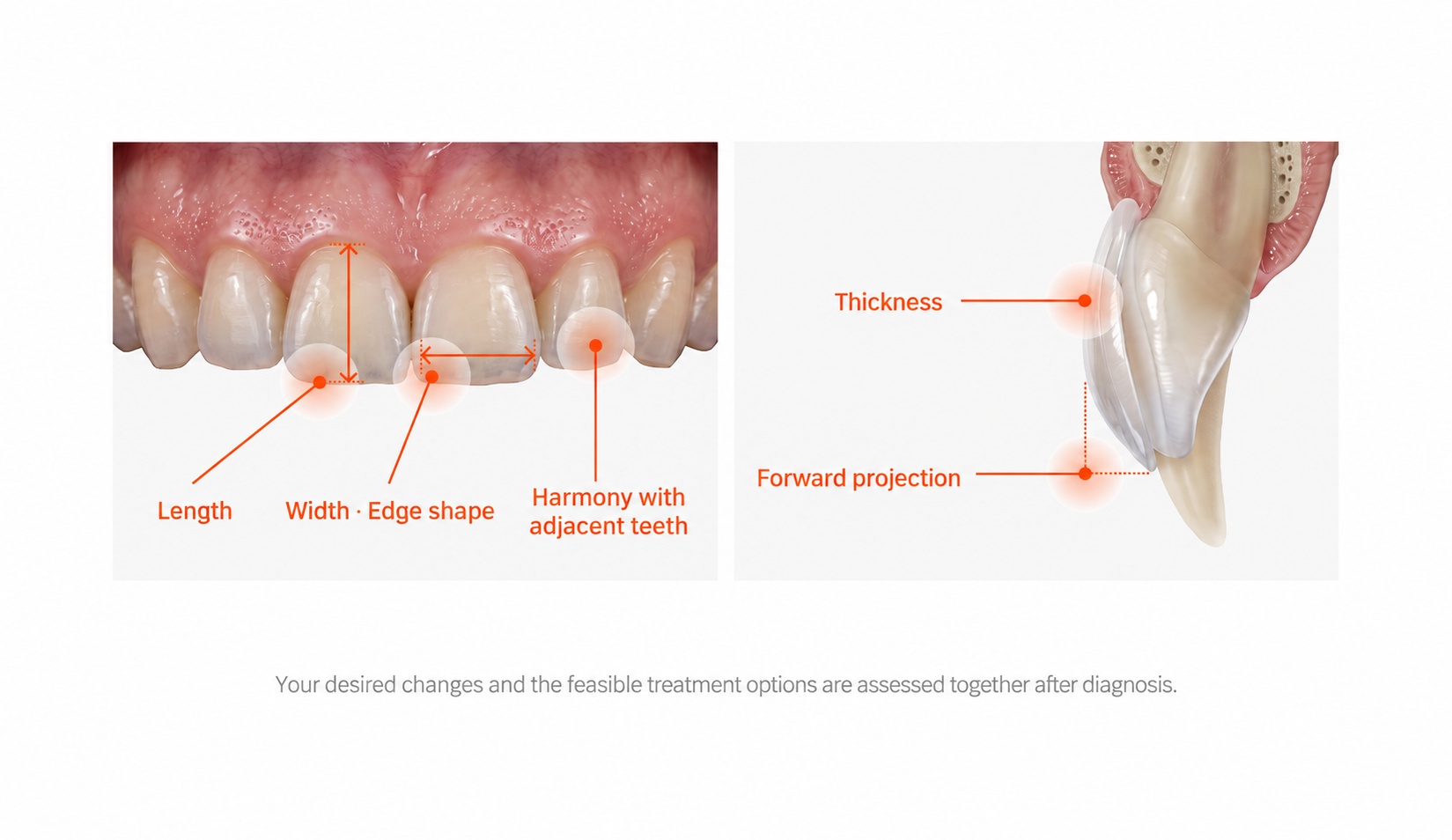
If you are considering veneer retreatment because of an aesthetic concern, begin by identifying which tooth and which feature you want to change. Breaking down the feeling that the result “does not look natural” into length, width, thickness, contour, and harmony with nearby teeth can make your goals easier to communicate.
- Length: Does the edge of a front tooth look too long, or does its length look out of balance with the adjacent teeth?
- Width and contour: Does a tooth look too wide or square? Do the corners or edges look sharper than you prefer?
- Thickness and projection: From the front and the side, does part of the veneer look bulky or project forward?
- Harmony with nearby teeth: Consider left-right balance, the transition into adjacent teeth, and the overall appearance of your smile.
Instead of saying, “I want all my veneers redone,” it can be more useful to say, “I would like the edges of my front teeth to look shorter,” or “I would like to change the area that looks thick from the side.” Also point out what you would like to keep and what you would prefer to avoid.
Appearance alone cannot confirm the actual thickness of a restoration or the cause of a problem. The change you want and the treatment that is possible may not be identical, so the achievable range and its limitations need to be assessed together.
If a Veneer Is Chipped, Detached, or Uncomfortable When You Bite, Does Everything Need to Be Replaced?
Chipping, detachment, or bite discomfort does not automatically mean that every veneer must be replaced. A small chip in an otherwise satisfactory veneer, repeated chipping in the same area, and a veneer that has detached completely require different assessments.
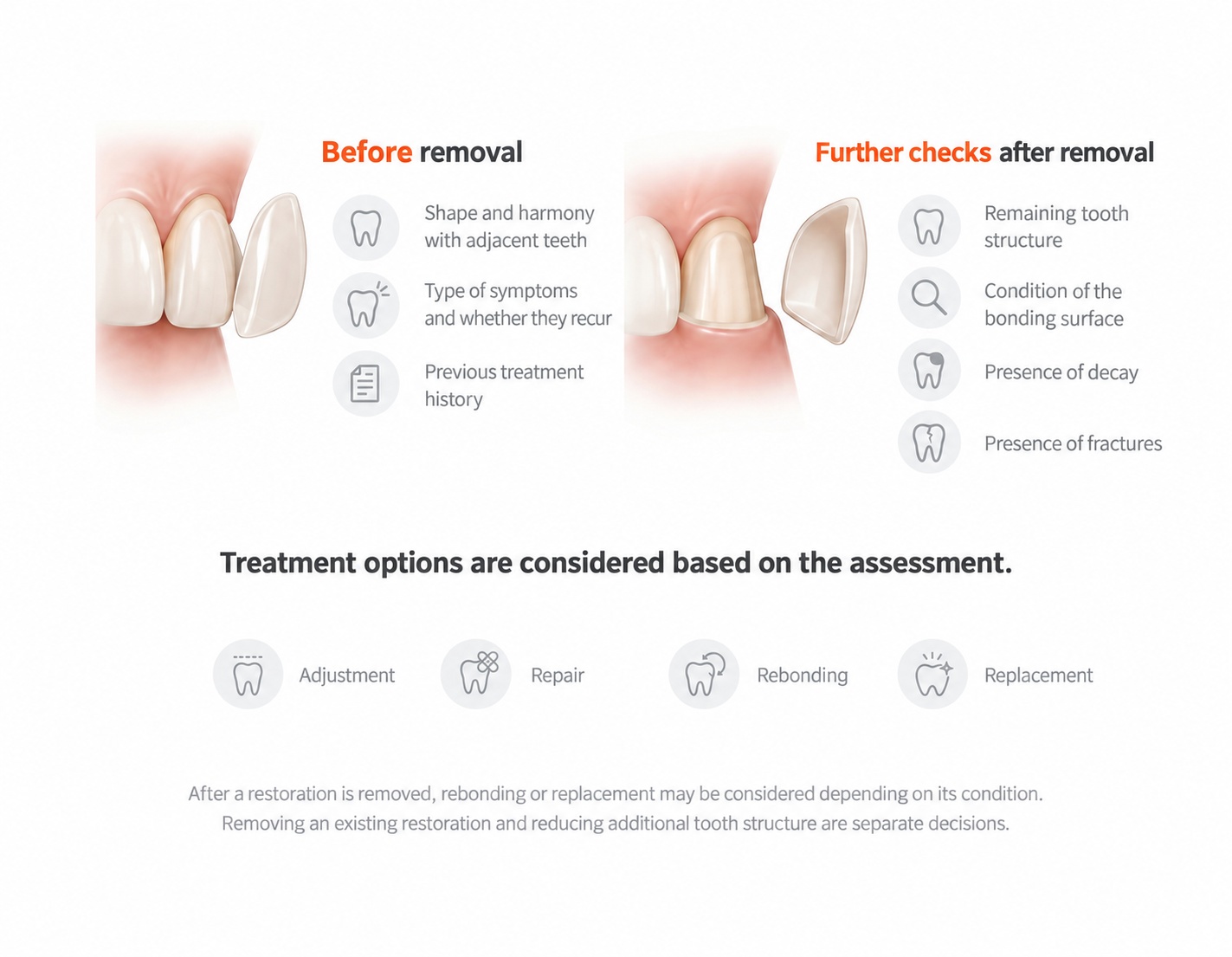
An adjustment keeps the existing restoration while refining its shape or surface. A repair preserves the restoration and restores a damaged area. Rebonding considers whether a detached restoration can be attached again. Partial or full replacement involves fabricating a new restoration for some or all of the affected area.
The choice depends on the location and extent of the damage, whether the problem has recurred, the condition of the restoration and bonding surface, harmony with the surrounding teeth, and the way the teeth meet. If a bulky appearance and bite discomfort occur together, describe both the aesthetic and functional concerns during the same consultation.
Veneer Retreatment: What to Check for Each Aesthetic or Functional Concern
Concern | Key point | What to ask during your consultation |
|---|---|---|
Front teeth look too long or wide | The possible adjustment depends on the desired length and width, proportions with nearby teeth, and the condition of the existing restoration. | Can only the edge be refined? If adjustment is not suitable, why is replacement being considered? |
Veneers look thick or project forward | The reason for the bulky appearance and the condition of the tooth and restoration need to be assessed. Partial replacement and additional tooth reduction are separate decisions. | Can only the bulky-looking restoration be replaced? If further tooth reduction is considered, why is it needed? |
Edges look angular or uneven beside nearby teeth | Changing one area still requires consideration of balance with teeth that will be retained and the overall smile. | Which features can be changed or retained, and when can I review the proposed new shape? |
Part of a veneer is chipped or the same area repeatedly chips | The location, extent, and recurrence of the damage help determine whether repair or replacement is considered. | Can only the damaged area be repaired? Why may it be recurring, and why are other options not being selected? |
A veneer detaches or the bite feels uncomfortable | Detachment requires evaluation of the restoration and bonding surface; bite discomfort requires evaluation of how the teeth meet and other possible causes. | Is rebonding possible? What may be causing repeated detachment or bite discomfort, and is adjustment or replacement being considered? |
What Can Be Assessed Before Removal May Differ from What Is Found Afterward
During a retreatment consultation, separate what can be evaluated while the existing veneers remain in place from what may only become clear after removal.
Before removal, the visible shape, harmony with nearby teeth, symptoms and their recurrence, and available treatment history can be used to discuss what you want to change and what you want to keep. The condition of the tooth and bonding surface beneath the restoration, however, may require further assessment after removal. Ask which findings could change the initial plan.
Removing an existing veneer and reducing additional tooth structure to create a new shape are separate decisions. Previous veneer treatment does not guarantee that no further tooth reduction will be needed. If decay, gum disease, or another issue requires treatment first, ask why that treatment needs to come before the veneer retreatment.
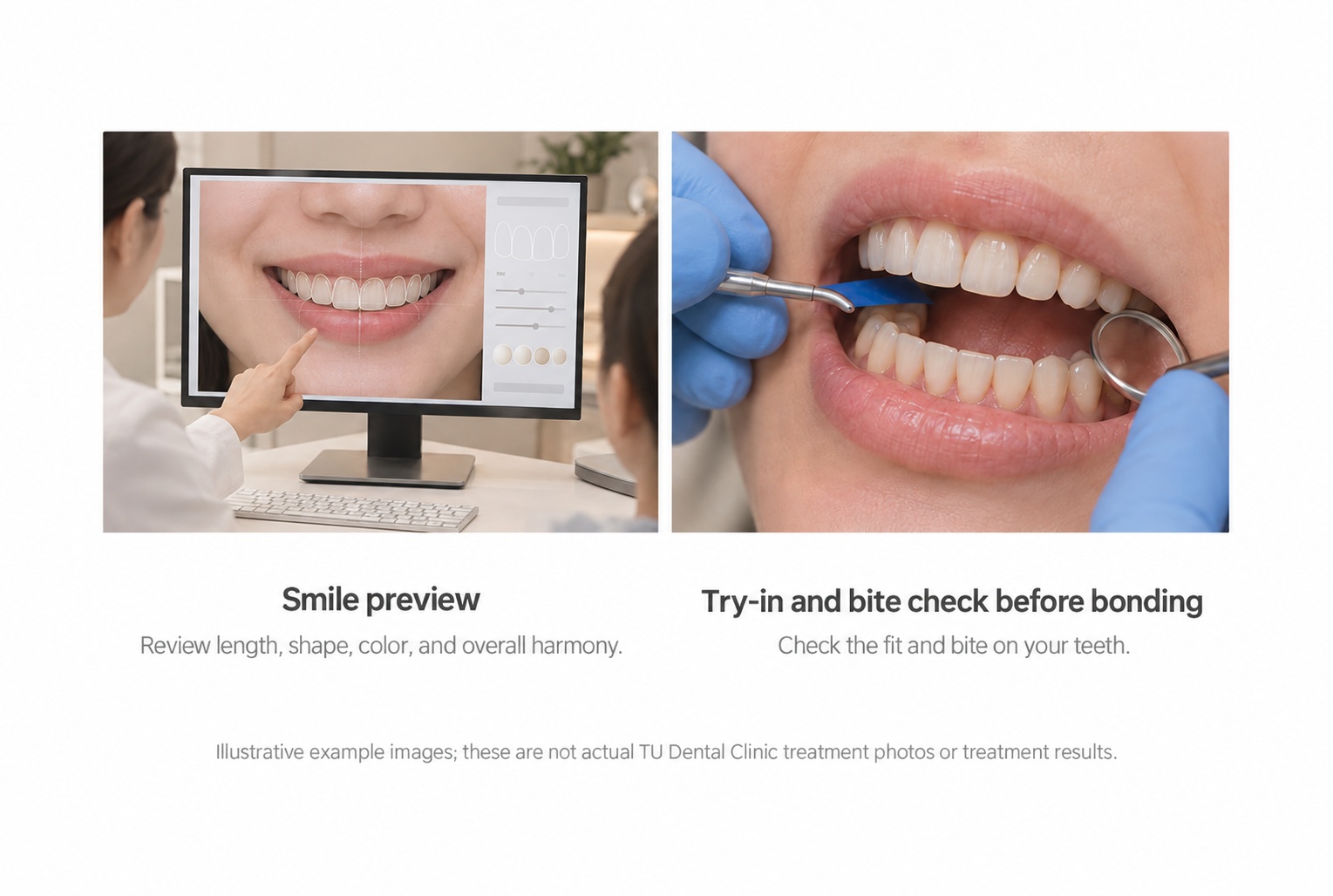
TU Dental Clinic’s published ZERONATE treatment process describes consultation and diagnosis, design planning, a smile preview, and a check before final bonding. For retreatment, ask when a preview or try-in—the process of fitting the restoration before final bonding—may be possible in your situation. Length, contour, color, harmony with nearby teeth, and the bite should be reviewed together. A preview supports discussion of the design direction; it does not guarantee a result identical to a reference image.
What Should You Check If You Are Considering Replacement with ZERONATE?
When considering replacement with ZERONATE, discuss not only the new appearance but also how to preserve the remaining natural tooth structure and address any functional discomfort.
ZERONATE is TU Dental Clinic’s premium laminate veneer brand, built around its philosophy of preserving natural teeth. It seeks to preserve natural tooth structure with a thickness close to zero and to realize the health and beauty of ideal natural teeth.
The phrase “a thickness close to zero” describes a treatment direction and does not guarantee a no-preparation approach in every case.
TU Dental Clinic considers aesthetics and function in individualized design and also provides consultations for replacing existing veneers. Whether ZERONATE is suitable, whether additional tooth reduction is needed, and the actual treatment scope are determined after evaluating the teeth, gums, and bite.
Frequently Asked Questions
Can I Have a Consultation Without Records from the Previous Clinic?
If you do not have the records, mention this when booking and ask what materials would be useful. It may help to note the approximate treatment date, which teeth were treated, whether any repair or rebonding was performed, what you want to change, and what symptoms you currently have.
Can I Bring Photos of the Tooth Shape I Want?
Reference photos can help you explain preferred length, edge shape, and overall impression. Point out both what you like and what you would prefer to avoid. Whether another person’s tooth shape can be reproduced on your teeth is a separate question and requires an individual assessment.
What Should I Do with a Detached Veneer or Broken Fragment?
Tell the clinic that you have the restoration or fragment and ask whether to bring it and how to store it before your visit. Also explain when and how it detached or broke and whether you have pain or bite discomfort. Having the fragment does not by itself establish that rebonding or repair is possible.
Checklist Before Your Consultation
☐ Can I describe separately what I want to change about the shape and any chipping, detachment, or bite discomfort?
☐ When did the symptoms begin, and has the same problem happened repeatedly?
☐ Which options—keeping, adjusting, repairing, rebonding, partial replacement, or full replacement—may be possible, and why might another option be excluded?
☐ What can be evaluated before removal, and which findings after removal could change the plan?
☐ What aesthetic changes may be achievable, what may be causing the functional discomfort, and why might further reduction or prior treatment be needed?
☐ When and how can I review the new contour, color, and bite, and until which stage can design changes be discussed?
☐ How many visits and how much fabrication time may be needed, will a temporary restoration be used, and which parts of removal, fabrication, and aftercare are included in the quoted cost?
Related Articles
For more information about ZERONATE’s natural-tooth-preservation approach and the general process from consultation and design to final bonding, see:
TU Dental Clinic: Treatment and Consultation
At TU Dental Clinic, we focus on preserving natural teeth while providing aesthetic dental treatment, orthodontics, dental implants, and comprehensive dental care. We assess your teeth, gums, and bite to guide an individual treatment plan.
Provider: TU Dental Clinic
Main services: ZERONATE, aesthetic dental treatment, orthodontics, dental implants, and comprehensive dental care
Address: Seocho W Tower, 54 Seocho-daero 77-gil, Seocho-gu, Seoul, South Korea — 12F: TU Dental Clinic; 13F: TU MARTH edition
Medical Information and Advertising Notice
This article is informational medical advertising provided by a healthcare institution to explain general information about consultations, examinations, treatments, and procedures. Suitability, results, recovery, and adverse effects may vary depending on individual health, the treatment area, and clinical circumstances. This article does not replace a personal diagnosis or treatment plan. Before deciding on a procedure, please consult a qualified clinician to confirm an appropriate approach and plan for your needs.