

Gaps Between Front Teeth: Composite Bonding, Orthodontics, or Veneers?
If you notice a gap between your front teeth when you smile, you may wonder whether to fill the space or move the teeth closer together with orthodontic treatment. You may also be considering veneers but feel unsure about how much tooth structure would need to be removed—or whether your front teeth would look too large.
The options to compare depend on whether you want to close the gap alone, correct tilted teeth or a bite that does not fit together properly, or also change the color and shape of your front teeth. Composite bonding can be considered for a small gap and localized changes in shape, while orthodontics addresses tooth position and bite. If substantial tooth movement is not needed and you want to improve spacing, color, shape, and proportions together, laminate veneers are worth serious consideration.
Even when gaps look similar, the appropriate treatment depends on their cause and the condition of the teeth and gums. Here, we explain what each of these three approaches can change, with particular attention to the factors to consider when choosing veneers.
Can a Gap Between Front Teeth Simply Be Filled?
If the teeth and gums are healthy and the space is related to tooth shape, treatment to fill the gap may be considered. However, gaps between front teeth have several possible causes, so a visible space does not mean the same treatment is right for everyone.
- Tooth size and number: Small teeth or missing teeth can leave spaces.
- The lips and tongue: A large or thick labial frenum—the tissue connecting the inside of the upper lip to the gums—or a habit of pushing the tongue against the front teeth when swallowing may be associated with spacing.
- Gum disease: Damage to the tissues supporting the teeth can allow them to shift and gaps to develop.
If a gap has appeared recently or is getting wider, especially with bleeding or swollen gums or loose teeth, a dentist should first assess the cause. When gum disease is responsible, inflammation is treated before planning how to address the space. A gap caused by a missing tooth also calls for consideration of treatment for the missing tooth.
How Do Composite Bonding, Orthodontics, and Veneers Differ?
Composite bonding adds material, orthodontics moves teeth, and veneers change shape and color by bonding custom restorations to the front surfaces of the teeth. The table below offers a starting point for comparison. The choice depends on tooth proportions and the bite—how the upper and lower teeth meet—as well as the size of the gap.
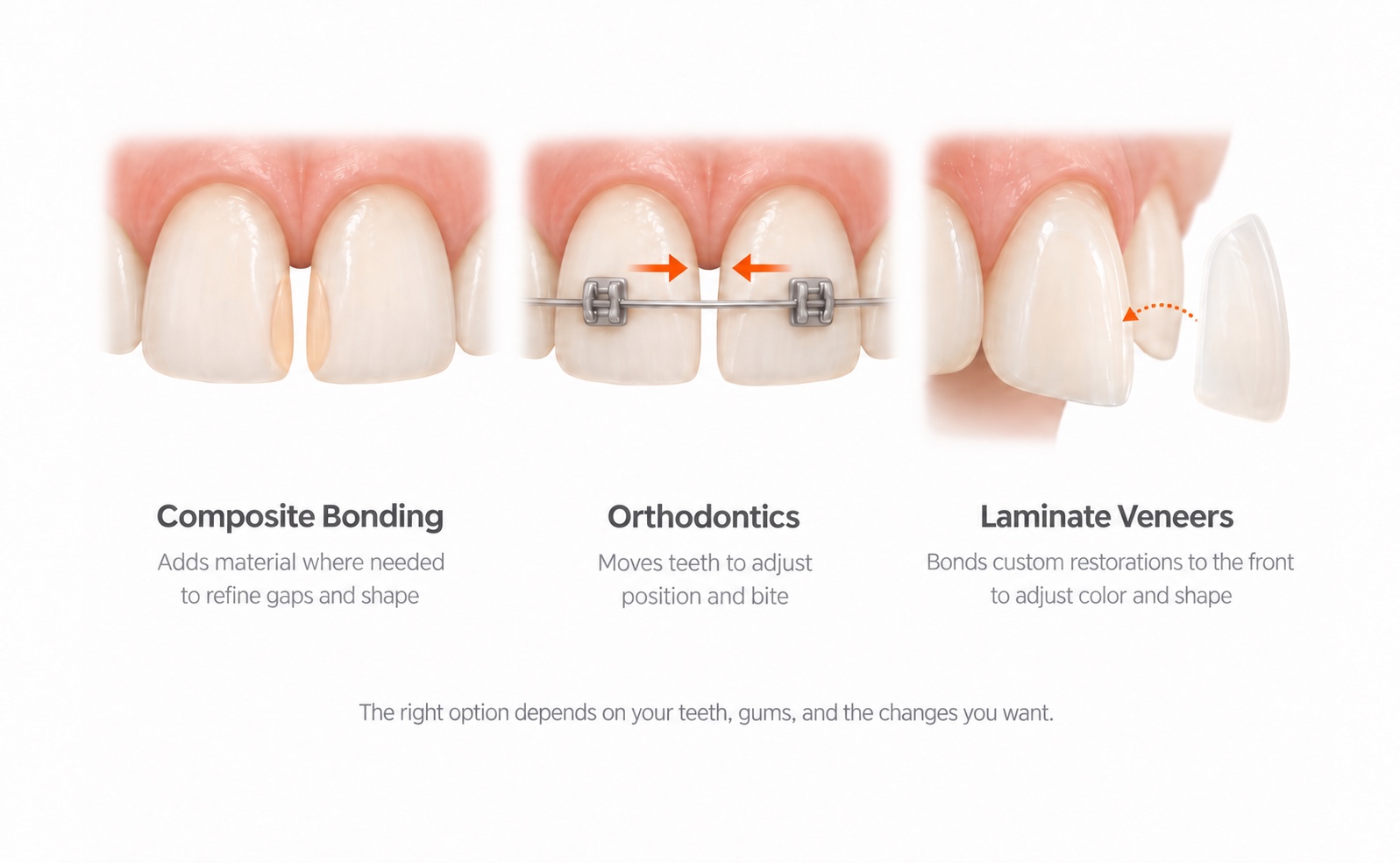
| Treatment Name | Description |
|---|---|
| Composite Bonding | Adds material where needed to refine gaps and shape |
| Orthodontics | Moves teeth to adjust position and bite |
| Laminate Veneers | Bonds custom restorations to the front to adjust color and shape |
The right option depends on your teeth, gums, and the changes you want.
Comparison | Composite bonding | Orthodontics | Laminate veneers |
|---|---|---|---|
What changes? | Tooth-colored composite resin is added directly to adjust width and shape | Tooth position, alignment, and bite | Color, shape, size, and proportions of the front surfaces, using custom ceramic restorations |
When might it be considered? | The main goal is to close a small gap between front teeth or refine a localized area | Spacing needs to be addressed along with tilted or rotated teeth, alignment, or bite | The goal is to improve front-tooth spacing, color, shape, and proportions together, without major tooth movement |
What improvement is possible? | Added material can reduce spaces and refine tooth shape where needed | Moving teeth can improve spacing and alignment | Spaces between front teeth and the overall design of their front surfaces can be improved together |
What care is needed? | Check color, surface, margins, and chipping; repair when needed | Oral hygiene and appointments during treatment, followed by retainer wear | Check bonding, bite, and gums; consider repair or replacement if a veneer fractures or comes off |
What should you ask about? | Whether added material will leave a natural-looking width and contour | The amount of movement, treatment time, and any color or shape concerns that may remain | Required tooth reduction, final thickness, width-to-length proportions, and harmony with neighboring teeth |
Composite Bonding for Small Gaps or Localized Shape Changes
Composite bonding adds material directly to the teeth to close a gap and refine their shape. It can be considered when you are happy with your teeth’s existing color and overall shape and mainly want to reduce a small space. The contact between the teeth and the contours near the gums also need to be shaped naturally.
After treatment, the color match with neighboring teeth and any changes to the surface or margins should be checked. It is also helpful to discuss maintenance and whether damage could be repaired. Composite resin can sometimes be used to change color or reshape a wider area, so the desired improvement and the extent of material needed should be considered together.
Orthodontics When Tooth Position and Bite Need to Change
Orthodontic treatment applies forces to move teeth into different positions. If front teeth are tilted or rotated, the plan needs to address how their position can be corrected. Even a larger space may be evaluated to see whether moving the teeth can reduce it.
Straightening the teeth does not necessarily resolve concerns about their natural color or size. In some cases, selected areas are reshaped with restorations after orthodontic treatment. Alongside treatment time and appointments, consider oral hygiene and retainers to help prevent teeth from shifting again after treatment.
When Are Veneers Suitable for Gaps Between Front Teeth?
Veneers may be considered when major changes to tooth position or bite are not needed and you want to improve color, shape, and proportions as well as the gap. These custom restorations cover the front surfaces of the teeth and can improve color, shape, and spacing together.
Closing Spaces While Refining Color and Shape
If your only goal is to close a gap between your front teeth, you can compare a targeted approach using composite bonding. If you also want to change their color or address differences in shape and size, designing the entire front surface with veneers may be helpful. The extent of gap closure and the final width, length, and shade are then planned together.
Veneers can therefore be an efficient way to address several aesthetic goals in one plan. This does not mean they always require fewer treatment sessions or cost less than other options.
Assessing Whether Orthodontics Is Needed First
When a tooth-position or bite problem requires tooth movement, the dentist should first assess the need for orthodontic treatment rather than try to resolve the problem with veneers alone. Orthodontics may be considered first if protrusion or an unbalanced bite would otherwise increase the amount of tooth reduction needed.
Understanding Tooth Reduction and Aftercare
Along with whether the desired shape is achievable, the following points should be explained:
- Tooth reduction: Removed tooth structure cannot be restored to its original state. Ask which areas need preparation, why, and how much natural tooth structure can be preserved.
- Sensitivity: Ask whether sensitivity could occur given the condition of your teeth and the extent of treatment.
- Repair and further treatment: Consider the possibility of needing further treatment if a restoration fractures or comes off, or if decay develops, along with ongoing care.
Will Veneers on Just Two Front Teeth Make Them Look Larger?
Increasing tooth width to close the gap can make the front teeth look wider. A space between the two central front teeth does not automatically mean that only those two teeth should be treated.
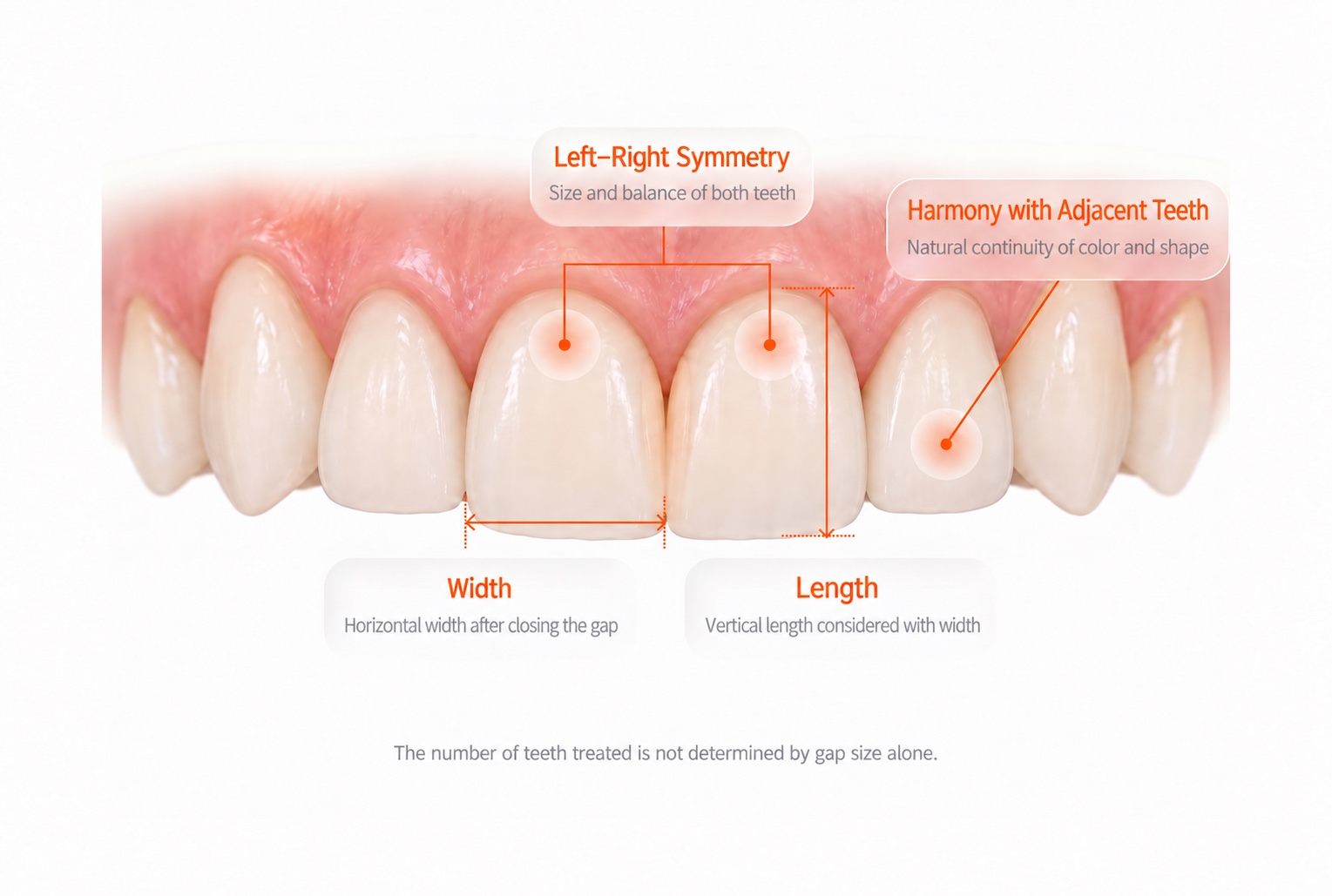
| Category | Description |
|---|---|
| Left-Right Symmetry | Size and balance of both teeth |
| Harmony with Adjacent Teeth | Natural continuity of color and shape |
| Width | Horizontal width after closing the gap |
| Length | Vertical length considered with width |
The number of teeth treated is not determined by gap size alone.
When assessing the planned result, the following points are considered together:
- Width and length: Will closing the space make the front teeth too wide relative to their length?
- Left–right symmetry: Do differences in tooth size or position mean substantially more material would need to be added on one side?
- Harmony with neighboring teeth: Will the color and shape of the two teeth blend naturally with the adjacent teeth?
- Side-view thickness and bite: In addition to closing the gap from the front, will the teeth look prominent from the side, and how will the upper and lower teeth contact each other?
If your front teeth are small and their proportions would remain balanced after filling the space, treating just two teeth may be considered. If they are already wide and those two teeth would have to fill the entire gap, orthodontic space management and the treatment scope should be reconsidered. The number of teeth treated is determined by their size, proportions, symmetry, and color harmony with surrounding teeth. Treating more teeth does not, by itself, produce a more natural result.
If You Are Considering Veneers, Could ZERONATE Be an Option?
Once a dentist has determined that veneers are suitable, the next step is to consider natural tooth preservation and the intended design.
ZERONATE is a premium laminate veneer brand that embodies TU Dental’s philosophy of natural tooth preservation. With a thickness close to zero, it preserves natural teeth while realizing the health and beauty of ideal natural teeth.
An individual diagnosis is needed because suitability, the need for tooth reduction, and the amount required depend on the condition of your teeth and the treatment plan. “Near-zero thickness” describes the brand’s design direction; it does not guarantee a completely no-prep approach for every tooth.
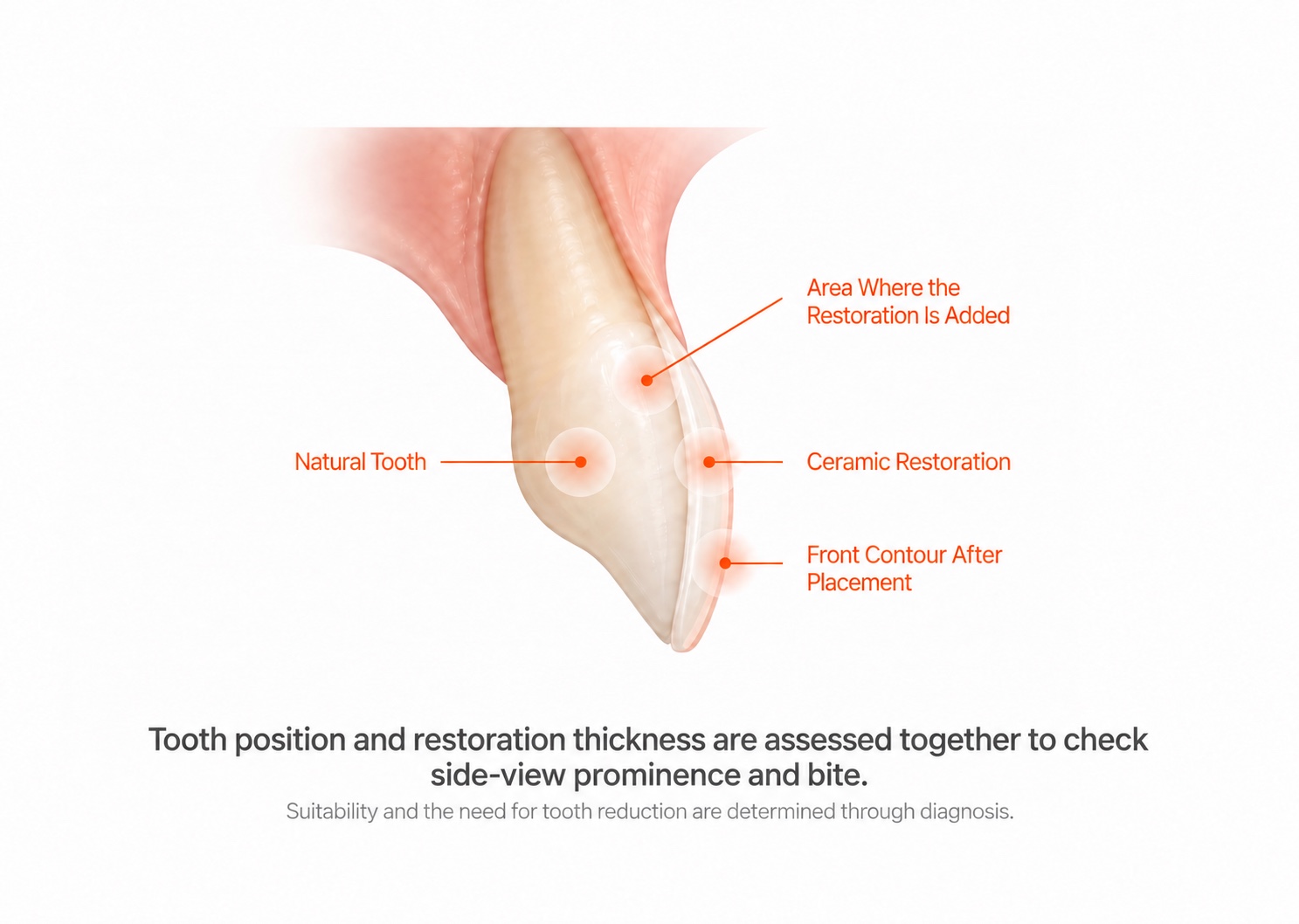
- Natural Tooth
- The main body of the tooth structure.
- Area Where the Restoration Is Added
- The specific surface location for the ceramic application.
- Ceramic Restoration
- The thin layer applied to the tooth surface.
- Front Contour After Placement
- The final outer shape of the tooth following restoration.
Tooth position and restoration thickness are assessed together to check side-view prominence and bite.
Suitability and the need for tooth reduction are determined through diagnosis.
When considering ZERONATE for a gap between front teeth, compare the proportions and thickness after closing the space, and how much natural tooth structure can be preserved. Beyond asking whether a no-prep approach is possible, ask which areas would need to change, by how much, and how the result would work with your bite and neighboring teeth. After the cause of the gap and your goals have been assessed, you can discuss a ZERONATE plan based on these criteria if veneers are suitable.
Frequently Asked Questions
Do Gaps Between Front Teeth Always Require Orthodontics?
No. If tooth position and bite need to change, orthodontics should be considered first. If the teeth and gums are healthy and the goal is to close a space or refine selected areas, composite bonding and veneers may also be options. Gap size alone does not determine the treatment.
How Do Bonding and Veneers Differ for Front-Tooth Gaps?
Bonding shapes the teeth by adding material directly. The veneers described here are custom ceramic restorations that are made separately and then bonded to the teeth. The comparison depends on whether you want a localized change or also want to adjust the color and shape of the front surfaces. Any necessary tooth preparation and ongoing care should also be considered.
Can Veneers on Two Front Teeth Look Natural?
They may be considered when color and shape differ little from the surrounding teeth and the proportions would remain balanced after closing the gap. If the two teeth would become too wide or look uneven, the approach to managing the space needs to be reassessed first.
Can No-Prep Veneers Make Front Teeth Look Bulky?
Because a restoration is added over the existing tooth, it can create a more prominent appearance depending on tooth position and the thickness needed. The existing position and the planned final thickness are assessed together to determine whether no-prep treatment is possible or selective tooth reshaping—adjusting only the areas that need it—is required. The term “no-prep” alone does not tell you whether the result will look natural.
Is ZERONATE Just Another Name for Conventional Veneers?
ZERONATE is TU Dental’s premium brand within the laminate veneer category. It reflects the clinic’s philosophy of preserving natural teeth and its approach to achieving that goal. It is not a separate fourth treatment alongside bonding, orthodontics, and veneers.
Checklist Before Your Consultation
You do not need to choose a procedure before your consultation. Consider whether you want to close the front-tooth gap alone or also change tooth position, bite, color, or shape, and discuss the following questions:
☐ What is the main cause of my front-tooth gap, and is there a gum problem that needs treatment first?
☐ Which of bonding, orthodontics, and veneers are suitable for me, and which are not?
☐ If only two front teeth are treated, will their width, length, symmetry, and color look natural alongside the neighboring teeth?
☐ If I choose veneers, which areas would need tooth reduction, and how would the final thickness change?
☐ Why would ZERONATE be suitable for my teeth and the changes I want?
☐ How do the options compare in maintenance, possible repairs or further treatment, expected time, and total cost?
Related Articles
Before deciding on the treatment scope, explore how many front teeth to improve and when orthodontics may be needed first.
- Number of ZERONATE Veneers: Partial vs. Full Improvement
- When Is Orthodontic Treatment Needed Before ZERONATE?
TU Dental Clinic: Treatment and Consultation
At TU Dental Clinic, we focus on preserving natural teeth while providing aesthetic dental treatment, orthodontics, dental implants, and comprehensive dental care. We assess your teeth, gums, and bite to guide an individual treatment plan.
Provider: TU Dental Clinic
Main services: ZERONATE, aesthetic dental treatment, orthodontics, dental implants, and comprehensive dental care
Address: Seocho W Tower, 54 Seocho-daero 77-gil, Seocho-gu, Seoul, South Korea — 12F: TU Dental Clinic; 13F: TU MARTH edition
Medical Information and Advertising Notice
This article is informational medical advertising provided by a healthcare institution to explain general information about consultations, examinations, treatments, and procedures. Suitability, results, recovery, and adverse effects may vary depending on individual health, the treatment area, and clinical circumstances. This article does not replace a personal diagnosis or treatment plan. Before deciding on a procedure, please consult a qualified clinician to confirm an appropriate approach and plan for your needs.