

Decay Under a Dental Veneer: Does the Veneer Always Need to Be Removed and Replaced?
A cavity in a tooth with a veneer does not always mean the veneer must be removed and remade. If the decay can be reached for treatment and the existing restoration remains securely bonded, treatment may be possible while keeping it in place. Removal is needed when decay extends widely beneath the restoration or the bond has deteriorated to the point that a localized repair cannot resolve the problem.
Where does decay “under a veneer” actually occur?
Decay develops in the natural tooth beneath or around a veneer, rather than in the veneer itself. Even after a veneer is placed, the natural tooth can still develop cavities.
A veneer mainly covers the front surface of a tooth. “Decay under a veneer” may refer to decay at the margin where the restoration meets the tooth, directly beneath it, or on an uncovered surface such as the back of the tooth or between teeth. Decay on the tongue-facing surface is approached differently from decay directly beneath a restoration on the front. If decay on the back is separate from the restoration, it may be possible to treat that area alone. If it extends underneath the restoration, treatment may need to cover a larger area than is visible from the outside.
Can a cavity be treated without removing the veneer?
If the decay is limited, instruments can reach it, and the existing restoration can remain stable after treatment, localized treatment may be considered.
Findings | Treatment to consider | Implications for the existing veneer |
|---|---|---|
Early decay before a hole has formed | Fluoride, oral hygiene measures, and monitoring | The restoration may be kept in place if it is in good condition |
Localized decay away from the restoration, such as on the back of the tooth | Treating and filling the affected area | Assess whether treatment can be carried out without disturbing the restoration |
A small cavity at the margin that instruments can reach, with a stable restoration | Treating the decay and repairing the area with composite resin or another suitable material | Repair only the affected area while keeping the existing veneer |
Extensive decay beneath the restoration, or marked lifting or fracture that makes localized treatment difficult | Removing the restoration, treating the decay, and restoring the tooth again | Reassess the type and extent of the new restoration |
For localized treatment, instruments must be able to reach the decay, and the area must be kept dry while the filling material is bonded. The restoration material and the condition of the remaining bond also matter.
Treatment planning considers both the new decay and the preservation of healthy remaining tooth structure. Replacing an entire restoration can lead to additional loss of healthy tooth tissue, so assessing whether a localized repair is possible is important.
Does a dark line at the veneer margin mean decay?
If the margin is discolored but there is no damage involving mineral loss from the tooth, it may be staining rather than decay. Color in a photograph alone is not enough to distinguish the two.
During an examination, the dentist checks for gaps at the margin, lifting of the restoration, and changes to the tooth surface. When needed, dental X-rays help assess the location and depth of decay. Surface staining may be managed with cleaning or polishing, whereas decay requires treatment appropriate to its stage.
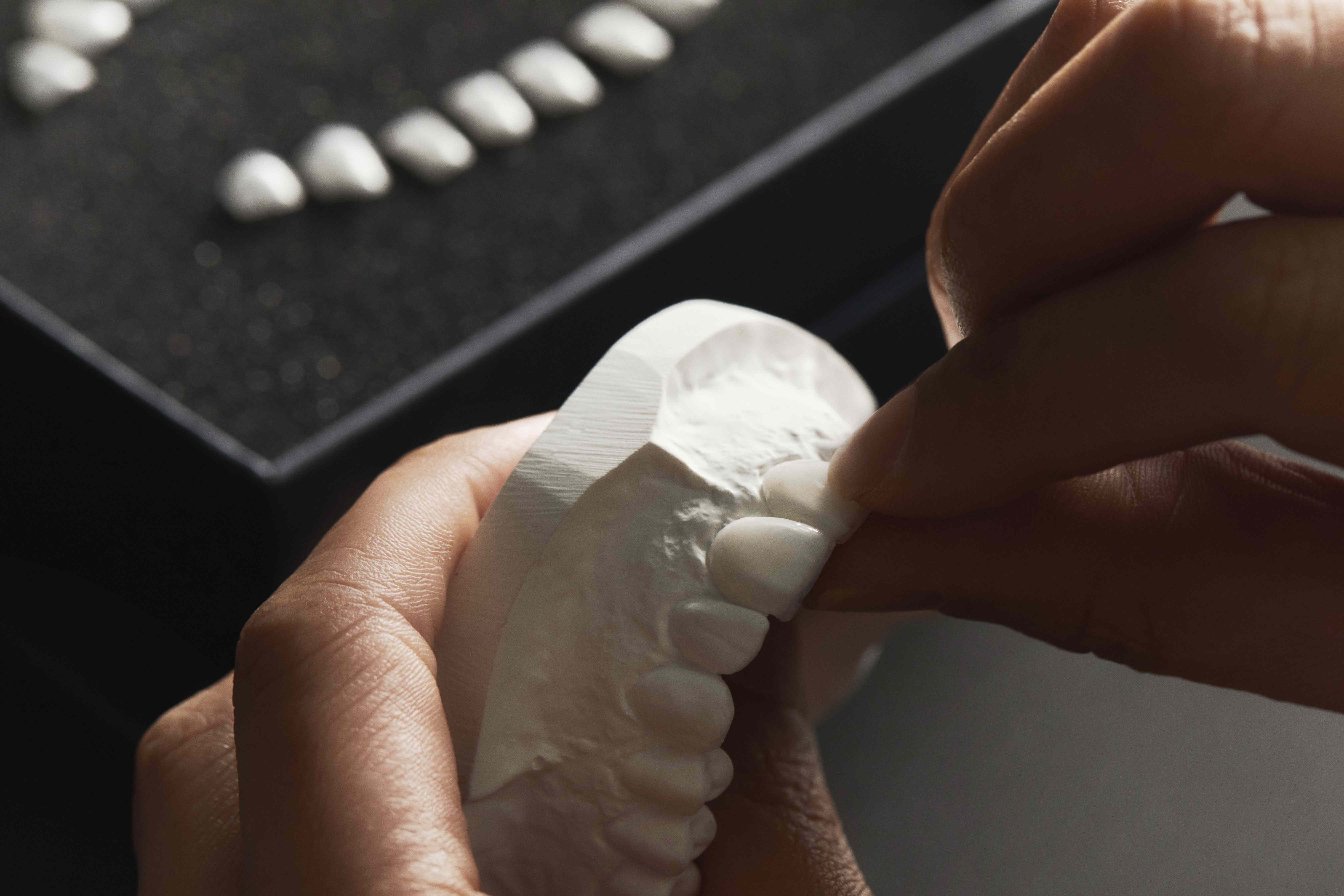
If the veneer must be removed, can I have another one?
After treating the decay, the dentist checks whether enough tooth structure remains to support a veneer and whether a surface for bonding a new restoration is available. These findings guide the next treatment. A restoration similar to the original may be possible, but substantial tooth damage may require a different type.
- Enough tooth structure and bonding surface remain: A new veneer may be considered after the decay is treated. Its color, shape, and bite must also be coordinated with the existing restorations and surrounding teeth.
- Extensive damage leaves inadequate support: If covering only the front surface would not adequately protect the tooth, a restoration with broader coverage, such as a crown, may be considered.
- Decay has reached the pulp inside the tooth: Root canal treatment may be needed. The need for root canal treatment and the choice of final restoration are separate decisions, based on pulp health and the remaining tooth structure, respectively.
Whether the removed restoration can be reused is a separate question. It may be damaged during removal, or changes in tooth shape after decay treatment may mean that it no longer fits. Treatment is therefore not planned on the assumption that the existing restoration will be reused unchanged.
Whether a veneer can continue to be used after decay treatment depends more on the condition of the remaining tooth than on how many years the veneer has been in place.
Can I delay treatment if it does not hurt?
The timing of decay treatment depends on how far the decay has progressed, rather than on pain alone. Early decay often causes no symptoms; sensitivity or pain may appear as it progresses. Before a hole forms, fluoride and other measures may stop or reverse decay, but once a cavity has formed, a filling is usually needed.
Arrange a dental visit if new discoloration appears at the margin, food repeatedly gets trapped in the same spot, or sensitivity persists. Seek prompt dental care if severe pain, swelling of the gums or face, or fever occurs.
After treatment, brush twice a day with fluoride toothpaste and clean between your teeth daily with floss or another suitable tool. Care is needed not only on the veneer surface but also at the tooth–restoration margin and near the gums. Check-up intervals should reflect your decay risk and the condition of the existing restoration.

TU MARTH edition
Suite 1304
Decay treatment and veneer restoration consultations at TU Dental Clinic
Through its comprehensive dental care service, TU Dental Clinic provides care appropriate to the stage of decay, from monitoring and fluoride care to composite resin restorations, and root canal treatment and crowns when needed. For teeth with veneers, the clinic first assesses decay and gum health, then determines the extent of treatment with preservation of the remaining tooth in mind.
If a new veneer is needed after decay treatment and you also want to improve the color or shape of your front teeth, ZERONATE may be considered.
ZERONATE is TU Dental Clinic’s premium laminate veneer brand, embodying its philosophy of preserving natural teeth. With its near-zero thickness, it preserves natural teeth and brings their ideal health and beauty to life.
For ZERONATE treatment, TU Dental Clinic assesses the teeth and gums and designs the color and shape with facial proportions, the smile line, and the bite in mind. After an existing restoration is removed, the remaining tooth structure and the extent of decay treatment are assessed to determine suitability and which areas, if any, need further shaping. Whether tooth preparation is needed, and how much, depends on an individual diagnosis.
Frequently asked questions
Can just the tooth with decay be treated?
If the problem is confined to one tooth and the other teeth and restorations are healthy, treatment can be planned around that tooth. The color and shape of a new restoration are considered in relation to the surrounding teeth, while any treatment needs of other teeth are assessed individually.
Will rebonding the veneer also fix the cavity?
Rebonding alone does not treat decay. The decay must first be managed according to its stage; rebonding may then be considered if the existing restoration is intact, fits the treated tooth, and is in a condition that allows it to be bonded again. If decay treatment changes the tooth’s shape so that the restoration no longer fits, or if the restoration is damaged, a new one may need to be made.
Can decay develop even with a no-prep veneer?
Natural teeth can develop decay regardless of whether they were prepared for veneers. Keep the margins and spaces between teeth clean, and have decay and bonding assessed at regular check-ups.
Will removing a veneer mean more of my tooth has to be reduced?
Treating tissue damaged by decay and shaping a tooth to place a new restoration are different procedures. Any areas requiring further shaping depend on the extent of decay, the remaining tooth structure, and the form of the new restoration; retreatment does not automatically mean removing a fixed additional amount of tooth structure.
Questions to ask at your consultation
☐ Is the decay on the back of the tooth, at the veneer margin, or directly underneath it?
☐ Can it be treated while keeping the existing restoration? If removal is needed, why?
☐ What restoration will be needed after decay treatment, and how will reuse versus remaking be assessed?
☐ If further tooth shaping is needed, which areas need it and why?
Related reading
For an explanation of ZERONATE and its suitability criteria, see What Is ZERONATE? A Complete Guide.
For other reasons to consider replacement, including fractures, detachment, and gum changes, see Veneer Lifespan and Criteria for Replacement and Retreatment.
Treatment and consultation information
TU Dental Clinic provides aesthetic dentistry, orthodontics, implants, and comprehensive dental care, with natural tooth preservation at the center of its approach. Individual treatment plans are based on a comprehensive assessment of the teeth, gums, and bite.
- Service provider: TU Dental Clinic
- Main services: ZERONATE, aesthetic dentistry, orthodontics, implants, and comprehensive dental care
- Location: TU Dental Clinic, 12F, and TU MARTH edition, 13F, Seocho W Tower, 54 Seocho-daero 77-gil, Seocho-gu, Seoul, South Korea
Medical information and advertising notice
This article is informational medical advertising prepared by a medical institution to provide general information about medical care, examinations, treatments, and procedures. Applicable methods, outcomes, recovery, and adverse reactions may vary according to an individual’s health, the treatment area, and specific clinical circumstances. This article does not replace an individual diagnosis or treatment plan. Before deciding on a medical intervention, consult a qualified clinician to confirm an appropriate method and a specific plan for your circumstances.