

Hairline Cracks in Front Teeth: What to Check Before Getting Veneers
Noticing a fine vertical line on a front tooth can make you worry that the tooth is starting to break. The line may be a shallow craze line limited to the outer surface, or a crack extending deeper into the tooth. Surface craze lines may only need monitoring, while deeper cracks or associated damage need appropriate treatment first. These conditions need to be distinguished before using veneers to change the tooth's appearance.
Why do hairline cracks appear in front teeth?
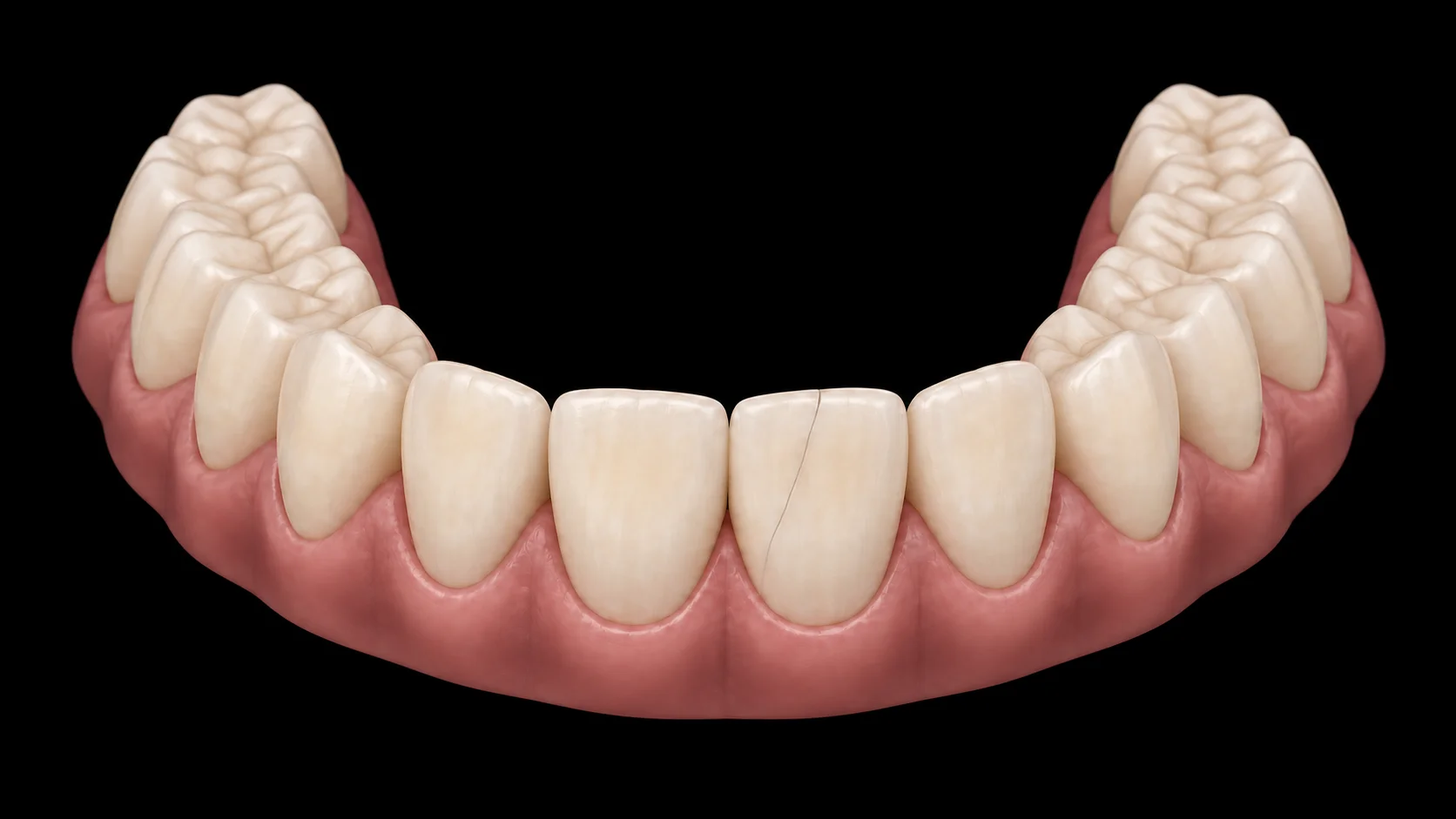
A blow to a front tooth is one possible cause, but repeated forces during everyday activities also matter. Biting hard objects such as ice or pens, clenching, and grinding can place stress on teeth. Surface craze lines are common in adults, but their cause and depth cannot be determined by appearance alone.
Tell your dentist about any recent injury, whether you use your front teeth to bite through hard objects, and whether you grind or clench. Managing these habits can reduce further stress; it does not bond an existing crack back together.
Do all hairline cracks in front teeth need treatment?
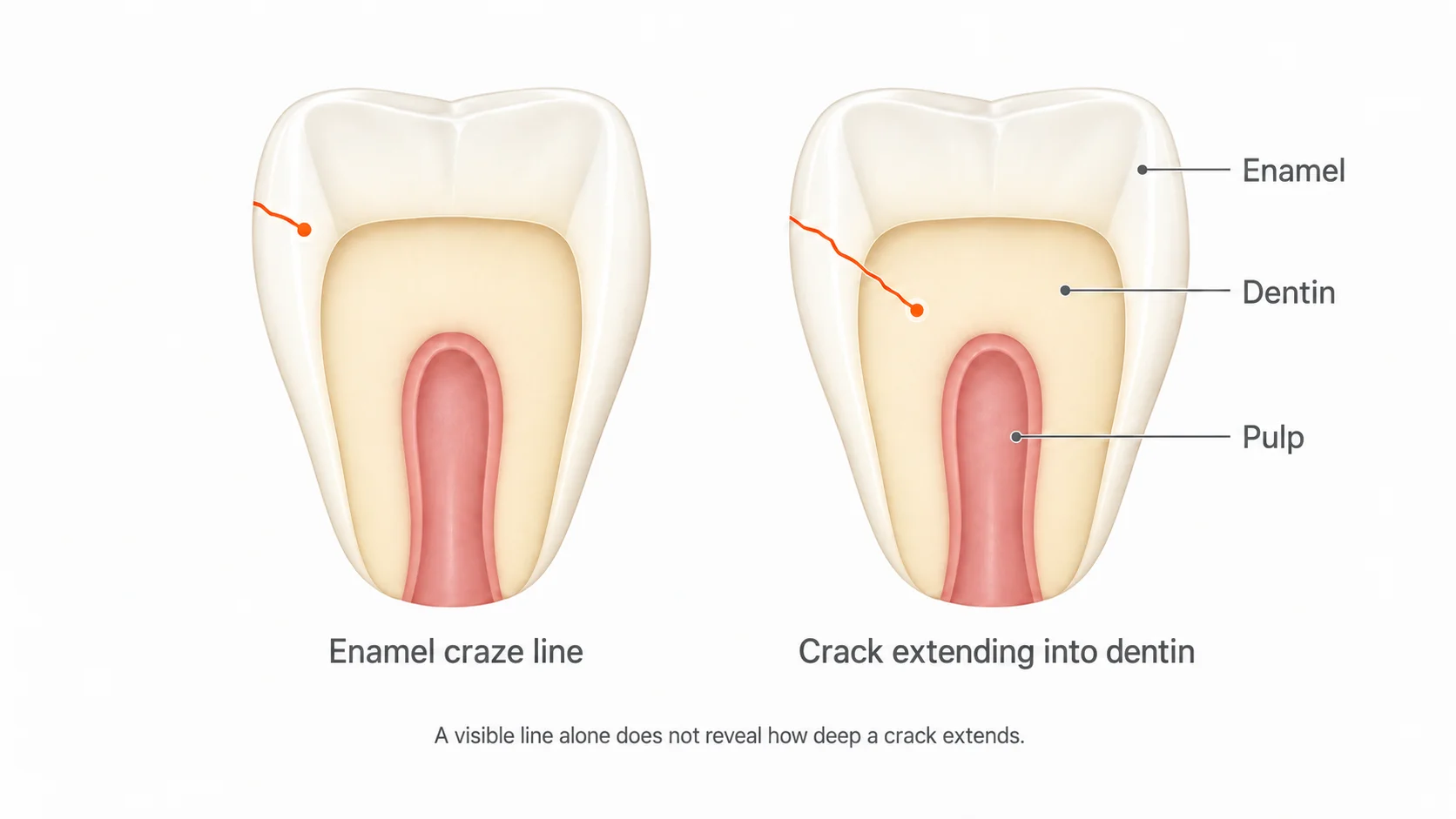
| Condition | Anatomy Labels |
|---|---|
| Enamel craze line | |
| Crack extending into dentin | Enamel, Dentin, Pulp |
A visible line alone does not reveal how deep a crack extends.
Enamel is the hard outer layer of a tooth. Shallow lines confined to enamel are common in adult teeth and do not, by themselves, cause pain. If an examination confirms a surface craze line and its appearance does not bother you, there is no need to remove tooth structure or place a restoration simply to eliminate the line.
A crack extending into the dentin beneath the enamel may affect the pulp, the tissue containing nerves and blood vessels inside the tooth. Deeper cracks can initially be painless, so the absence of pain does not establish that a line is superficial. A mirror or photograph cannot show the depth of the crack or the condition inside the tooth.
An injury history is particularly important if the line appeared after a recent blow. Even if no piece of tooth has broken off, the dentist needs to check for mobility or an accompanying root injury.
Which symptoms call for prompt dental care?
If you notice a line along with any of the following changes, contact your dentist and arrange an examination.
- Pain in a particular tooth when biting down or releasing pressure.
- Pain with hot or cold food and drinks.
- A loose tooth or a change in your bite after an injury.
- Swelling around the tooth or increasing pain.
Pain with chewing or temperature changes can occur with a crack, but other causes, including decay, need to be considered. In particular, dental trauma or swelling inside the mouth calls for prompt assessment. Before your appointment, avoid biting through hard food with the painful front tooth or repeatedly biting hard to test the pain.
How does a dentist check for a crack?
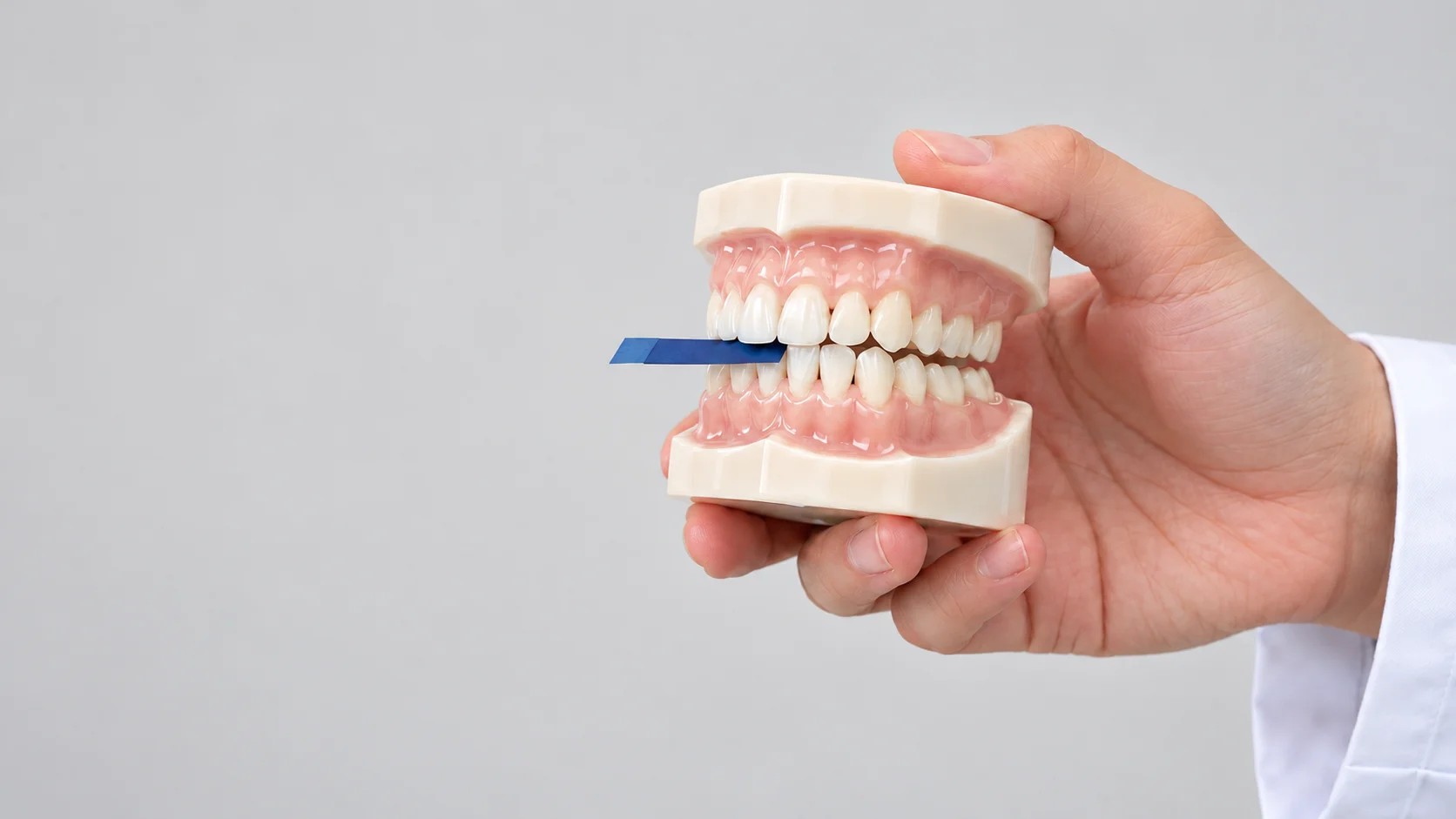
The examination assesses both the location of the visible line and how the tooth responds to stimuli. Depending on the situation, assessment may include magnification, shining light through the tooth (transillumination), pulp response tests, bite checks, and periodontal examination.
What is checked | What the findings help assess |
|---|---|
When the line appeared, injury history, and pain history | Whether damage followed an impact and which stimuli trigger symptoms |
Magnification and light transmission tests | The location and direction of cracks that are difficult to see |
Pulp responses to cold and other stimuli | The response of tissue inside the tooth and the need for further tests |
Bite tests, occlusion, and tooth mobility | Symptoms under load and the condition of the tooth's support |
Periodontal examination and radiographs | Changes around the tooth and root, including associated injuries |
Radiographs help assess the root and surrounding tissues, but early cracks may not be clearly visible on an image. Even if no line appears, the dentist considers symptoms and the clinical examination together. CT also cannot detect every microscopic crack; the examination findings determine whether additional imaging is needed.
How is the choice between monitoring and treatment made?
The purpose of treatment depends on the condition. Surface craze lines mainly raise cosmetic concerns. For cracks extending deeper into a tooth, protecting the remaining tooth structure and treating disease in the internal tissues become important.
Confirmed condition | Possible approach and reason |
|---|---|
A line limited to enamel, with no associated damage | Monitoring without treatment may be appropriate. If appearance is a concern, weigh the need for cosmetic improvement against the amount of tooth preparation. |
A pronounced crack confined to enamel after an injury | Sealing the surface with a bonding resin may be considered, depending on the condition. This is not necessary for every line. |
A deeper crack with pulp that can be preserved | Monitoring may be possible if the risk of progression is low. If protection is needed, a bonded restoration or crown may be considered according to the crack's extent and remaining tooth structure. |
Irreversible inflammation or death of the pulp | Root canal treatment addresses the internal tissue problem, alongside a restoration planned to protect the remaining tooth. |
A split tooth or confirmed vertical root fracture | The possibility of retaining the tooth is assessed first. Extraction may be necessary if it cannot be retained. |
Selective resin sealing of injury-related cracks confined to enamel treats the surface and has a different purpose from veneers that change a broader area of tooth color and shape. For deeper cracks, the pulp condition and remaining tooth structure guide the extent of restoration. A visible line in a front tooth alone is not a reason to choose a root canal or crown.
A longitudinal crack in a tooth is not expected to heal by joining back together on its own. Treatment aims to reduce pain and the likelihood of further damage, and follow-up remains necessary according to the tooth's condition.
Can a veneer cover the line?
If an examination confirms a surface craze line and the teeth and gums are healthy, cosmetic treatment may be considered based on how noticeable the line is and any changes you want to make to color or shape. Choosing no treatment is also an option if the appearance does not significantly bother you.
A veneer covers the front surface of a tooth to improve its color and shape. Its role differs from treating inflammation inside a tooth or protecting cracks in every direction. If a deep crack requires broader protection of the tooth or root canal treatment, that need takes priority over concealing the line on the front.
When considering a veneer, weigh the expected cosmetic change against the amount of healthy tooth structure that would be prepared. Removed enamel cannot be restored, and grinding, clenching, or a deep bite can affect suitability for veneers. First establish whether the crack needs treatment, then decide whether a veneer is appropriate for changing the appearance.
Assessing front-tooth health and ZERONATE at TU Dental Clinic
TU Dental Clinic provides comprehensive dental care, including treatment for decay and gum disease and conservative treatment appropriate to the tooth's condition. If a tooth with a visible line also has disease that needs treatment, the plan distinguishes treatment of that disease from cosmetic improvement. Decay is treated with a restoration appropriate to the damaged area, and pulp disease may require root canal treatment. Veneers do not replace these treatments.
After checking dental health, patients who also want to improve the color or shape of their front teeth can discuss whether ZERONATE is suitable.
ZERONATE is TU Dental Clinic's premium laminate veneer brand, embodying its philosophy of preserving natural teeth. With a thickness approaching zero, it is designed to preserve natural tooth structure and realize the ideal health and beauty of natural teeth.
Actual suitability, whether preparation is needed, and how much tooth structure must be removed depend on the individual's dental condition and treatment plan. A no-prep approach may be used when suitable; selective reshaping may be considered when necessary. For a front tooth with a visible line, the required protection or treatment is established first, before assessing whether changing the front surface's color and shape is appropriate.
Frequently asked questions
Can I leave a painless hairline crack in a front tooth alone?
If an examination confirms a surface enamel craze line with no associated problems, monitoring without treatment may be appropriate. However, deeper cracks can also be painless, so pain alone cannot classify a line that has not yet been examined.
If the line bothers me, should I consider composite resin or a veneer?
Once a surface craze line is confirmed, patients who want cosmetic improvement can discuss the need for and extent of composite resin restoration or ceramic veneers. Composite veneers may require less enamel removal than ceramic veneers and are relatively easy to repair, but are less resistant to staining and wear. Consider the desired color and shape, preparation, and maintenance together. Not every line needs resin, and cosmetic restoration does not replace treatment for a deeper crack.
Does a visible crack mean I need a root canal first?
A surface craze line alone does not require root canal treatment. This treatment is considered when irreversible inflammation or tissue death is confirmed inside the tooth; the crack's depth and pulp test findings help determine whether it is needed.
Will a veneer stop a crack from progressing?
Covering the front surface with a veneer is different from providing the extent of protection a cracked tooth needs. A deeper crack may require another restoration, such as a crown, or root canal treatment, so the appropriate protection is decided first.
If I grind my teeth, do I still need care after crack treatment?
Grinding and clenching can continue to place force on teeth and restorations. Avoid biting hard objects and, when appropriate, ask your dentist about a protective appliance. Such an appliance manages forces on teeth; it does not join an existing crack back together.
Questions to ask at your consultation
☐ Is the visible line limited to enamel, or does it extend deeper?
☐ Could pain or an injury history indicate additional damage that needs checking?
☐ Can the tooth be monitored without treatment now? Which changes should prompt a return visit?
☐ If a restoration is needed, how much of the tooth needs protection and preparation?
☐ Which cosmetic concerns could a veneer address, and which conditions need treatment first?
☐ Is a no-prep approach possible? If not, why, and what alternatives are available?
☐ How will the shape and bite be checked after bonding, and what care is needed if the restoration breaks or detaches?
Related reading
If a piece of tooth has already broken off, the method and extent of restoration may be your main concern. Chipped Front Tooth: When Are Veneers Appropriate? Comparing Composite Resin, Crowns, and Treatment Choices explains these differences (Korean article).
Dental care and consultations
TU Dental Clinic provides aesthetic dentistry, orthodontics, implants, and comprehensive dental care with a focus on preserving natural teeth. Teeth, gums, and occlusion are assessed together to guide an individual treatment plan.
- Provider: TU Dental Clinic
- Main services: ZERONATE, aesthetic dentistry, orthodontics, implants, and comprehensive dental care
- Location: Seocho W Tower, 54 Seocho-daero 77-gil, Seocho-gu, Seoul, South Korea — TU Dental Clinic on the 12th floor; TU MARTH edition on the 13th floor
Medical information and advertising notice
This article is informational medical advertising prepared by a medical institution to provide general information about consultations, examinations, treatments, and procedures. Suitable methods, outcomes, recovery, and adverse reactions may vary according to an individual's health, the area being treated, and the specific treatment conditions. This article does not replace an individual diagnosis or treatment plan. Before deciding on a medical procedure, consult a qualified clinician to confirm the approach and detailed plan appropriate for you.