How Long Do Veneers Last? When to Replace Them and What to Consider Before Redoing Them
If you're considering veneers, your biggest question is probably how long veneers last once they're placed. If you already have veneers, you may be more curious whether it's time to replace them.
Research combining multiple clinical studies shows that most ceramic (porcelain) veneers were still in place after 10 years. However, when a particular person's veneers should be replaced is decided by diagnosing their current condition, not by how many years they have been in use. That means checking not only whether a veneer has chipped or come off, but also the tooth and gums underneath, the bonded margin where the tooth and veneer meet, and how your upper and lower teeth bite together.
So having veneers for a long time doesn't automatically mean they need replacing, and having no pain doesn't mean you can skip check-ups. This article first looks at veneer lifespan and the conditions that help veneers last, then walks through the signs that call for a replacement review and six things to check before redoing veneers.
How Long Do Veneers Typically Last?
A systematic review combining 25 clinical studies of 6,500 porcelain veneers, based on data with at least 3 years of follow-up, reported an estimated 10-year cumulative survival rate of 95.5%. When reading this figure, keep three things in mind.
- It's a group average. Because it pools results from many patients and treatment conditions, it can't tell you how many more years one person's veneers will last or how long they are guaranteed.
- "Survival" is not the same as "unchanged." This review counted fracture, debonding, decay at the veneer margin, and teeth that came to need root canal treatment as failures. Surviving means a veneer wasn't judged a failure, not that its color, margins, or surrounding gums showed no change at all.
- These results are for ceramic (porcelain) veneers. They can't be applied as-is to other materials such as composite resin.
In the same review, the most common problem was fracture (chipping or cracking), followed by debonding (the veneer coming off). Both problems appeared more often in the first few years after placement. That's why a check-up right after placement, and regular check-ups after that, matter.
So is there a set replacement schedule for veneers? There is no fixed replacement cycle. Veneers without problems aren't replaced just because a certain number of years has passed, and on the other hand, veneers that are only a few years old should be checked if something changes. If you're wondering how long treatment takes, see the guide to veneer types, the treatment process, and cost.
Which Veneers Last Longer?
You may wonder which lasts longer: ceramic or composite, no-prep or minimal-prep, or ZERONATE. But these labels are categorized by different criteria, so they can't be ranked on a single scale. Ceramic and composite are materials, no-prep and minimal-prep are ways of preparing the tooth, and ZERONATE is a TU Dental Clinic brand. Ceramic veneers can also be no-prep, and even among no-prep veneers, how well they hold up depends on diagnosis, bonding, and care.
So when comparing which option lasts longer, it's more accurate to look at the four criteria below separately.
Criterion | Examples | Relation to lifespan | What to ask in consultation |
|---|---|---|---|
Material | Ceramic (porcelain), composite (resin) | Chipping, staining, and wear appear differently, and repair methods differ | Why that material is recommended, and how it's repaired if a problem arises |
Tooth preparation | No-prep, minimal-prep, selective preparation | Remaining enamel can favor bonding, but the amount of reduction alone doesn't determine lifespan | Which teeth are reshaped and why, and whether enamel remains after reshaping |
Brand | A veneer brand named by a dental clinic (e.g., ZERONATE) | A name that bundles standards for material, preparation, fabrication, and care; the name itself doesn't determine lifespan | The diagnosis, design, fabrication, and care standards that brand sets |
Diagnosis, fabrication, and care | Diagnosis, design, bonding process, bite adjustment, regular check-ups | Even with the same material, how well veneers hold up varies with bonding precision, bite, and whether check-ups happen | Check-up schedule after placement, how the bite is checked, and what happens if a problem arises |
Does Veneer Lifespan Differ by Material?
Veneers can broadly be divided into those made of ceramic (porcelain) and then bonded to the tooth, and those built up directly on the tooth with composite (resin). Each material has its own strengths and points to watch, so the changes that appear over time differ as well.
Category | Ceramic (porcelain) | Composite (resin) |
|---|---|---|
Strengths | Color is relatively stable and the surface is smooth | Can be applied directly to the tooth, and some damage can be repaired relatively simply |
Points to watch | Can fracture under strong impact or when force concentrates in one spot | Staining and wear may appear sooner over time |
If a problem arises | Partial repair or a remake is considered, depending on the extent of damage | Partial repair or rebuilding is considered, depending on the extent of damage |
Ceramic itself comes in many types. A literature review of the clinical performance of veneers summarized that feldspathic porcelain, leucite-reinforced ceramics, and lithium disilicate ceramics showed satisfactory performance. Which material suits you, however, depends on your tooth condition, the color and thickness you want, and your bite. Rather than judging lifespan by a material name alone, ask why that material is being recommended. For more on how composite and veneers differ, see the differences in materials, repair, and care between composite bonding and veneers.
Do No-Prep or Minimal-Prep Veneers Last Longer?
Many people wonder whether veneers that require little to no tooth reduction last longer. Before the name of the approach, the first thing to look at is what kind of tooth surface the veneer is bonded to.
Enamel, the outermost layer of the tooth, is the layer where stable bonding is easiest to achieve. A literature review also reported that the more the inner layer, dentin, was exposed during tooth preparation, the lower the success rate of ceramic veneers. In other words, preserving as much enamel as possible can be favorable for bonding.
That said, less reduction doesn't automatically mean veneers will last longer.
- Not every tooth can be treated without preparation. Depending on the tooth's position and shape and the change you want, some reshaping may be needed to create a natural thickness and form.
- Other factors matter too. Material and thickness, bite, grinding habits, and how well the veneers are cared for all affect how long they last.
- Problems can still occur with minimal reduction. If bonding isn't precise or force concentrates in one spot, veneers can fracture or come off.
So in consultation, along with asking "Is this no-prep?", check which part of which tooth will be reshaped and why, and whether enamel will remain after reshaping. To see how no-prep and minimal-prep actually differ, continue with this comparison of no-prep and minimal-prep veneers.
When Preserving Natural Teeth Is Your Priority: ZERONATE
ZERONATE is TU Dental Clinic’s premium laminate veneer brand, built on its philosophy of preserving natural teeth. With thickness approaching zero, it seeks to preserve natural tooth structure while bringing together the health and beauty of ideal natural teeth.
ZERONATE's standard is to consider no-prep first, depending on the condition of the teeth, and where needed, to selectively reshape the tooth only within the enamel. It is designed to preserve as much natural enamel as possible to create a sound bonding environment, and to reduce the factors that lead to fracture or debonding through precise design and fit.
However, "thickness approaching zero" does not mean that the actual reduction is zero for everyone. With ZERONATE as well, how long veneers last can vary with your bite, lifestyle habits, and regular check-ups. Whether ZERONATE can be applied and how much the teeth need to be reshaped are decided through diagnosis.
What Conditions Determine How Long Veneers Last?
How long veneers last is determined not by the material alone but by several conditions together. Some you can manage yourself, and some can only be assessed at a dental clinic.
Condition | Why it matters | What you can do | What the dental clinic checks |
|---|---|---|---|
Remaining tooth structure | It's the foundation the veneer bonds to, so it affects bonding stability | Share your previous treatment history | How much the tooth was reshaped, how much enamel remains, and signs of previous treatment |
Bonded margin | Where gaps, discoloration, and decay at the margin tend to start | Brush and floss along the margins and around the gums | Whether the margin fits well, and whether there is decay or discoloration |
Bite and grinding | Force concentrated in one spot makes fracture or debonding more likely | Avoid biting hard things with your front teeth; mention it if you suspect grinding | Whether certain teeth make contact first, and whether a protective appliance is needed |
Tooth and gum health | Decay or gum inflammation needs treatment separate from the veneers and also affects the margins | Keep up daily oral hygiene; mention any bleeding or swelling | Decay and gum condition |
Regular check-ups | Changes that are hard to see can be caught early | Keep to your check-up schedule | Bonding condition, bite, and changes in the gums |
Even if two people got veneers on the same day with the same material, how well those veneers hold up will differ if these conditions differ. That's why knowing what your own conditions are matters more than an average lifespan.
What Happens to Veneers as You Age?
Even if the veneers themselves stay the same, your mouth changes little by little with age. With veneers that have been in place for a long time, changes like these can occur.
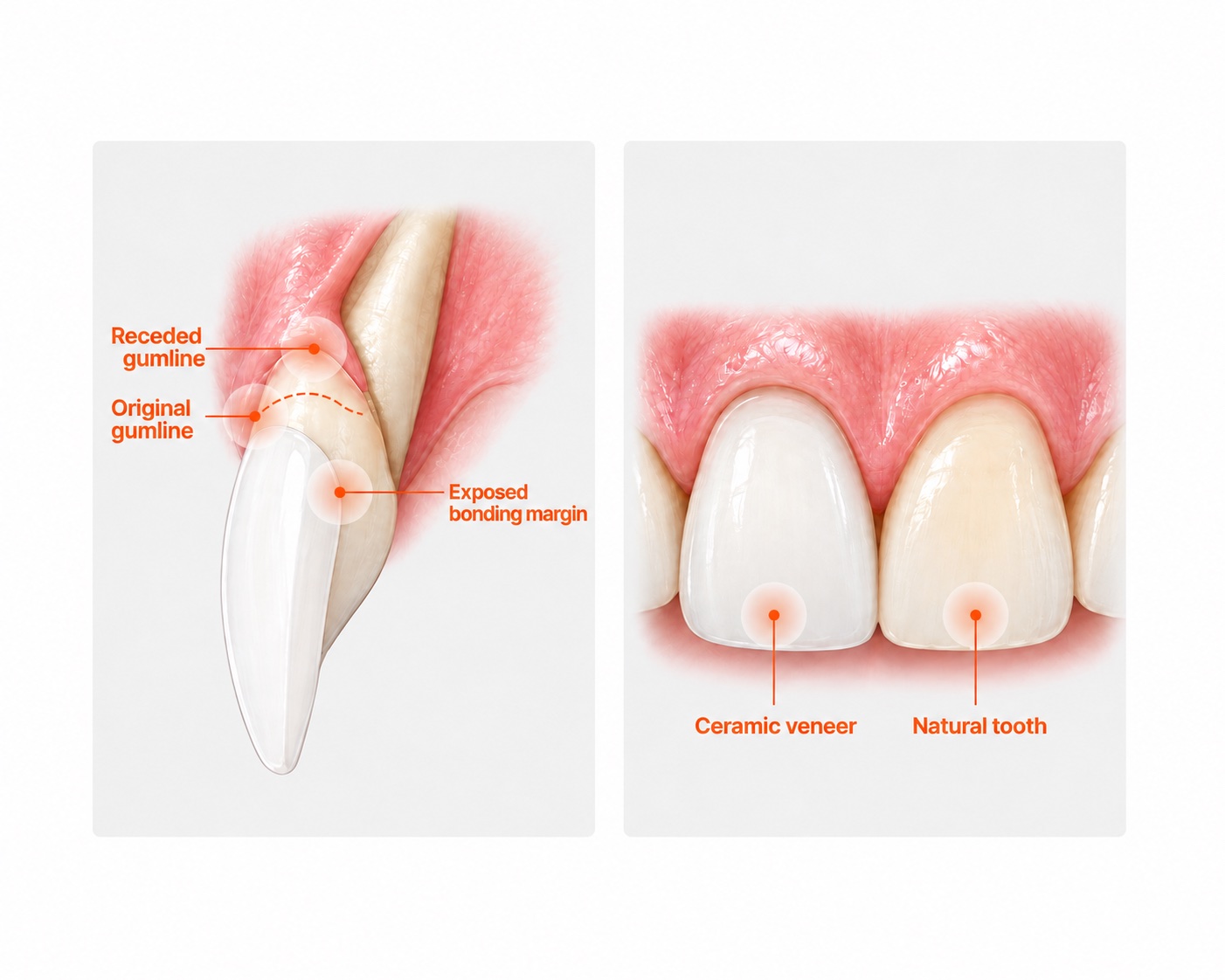
- The margin may become visible as the gums recede. As the gums gradually recede, the margin where the veneer meets the tooth can become exposed, making a line visible or making it easier for food to get trapped.
- A color difference with surrounding teeth may develop. Ceramic is relatively color-stable, but the surrounding natural teeth can change color over time, so the difference may look larger than it did at first.
- Your bite and wear may change. As teeth gradually wear down or shift, more force may fall on certain veneers.
These changes don't necessarily mean the veneers need replacing right away. Some can be managed with gum care or bite adjustment, and if there's no health problem and only the appearance has changed, you may not need to rush into replacement. However, if an exposed margin makes cleaning difficult, or if sensitivity or gum swelling appears along with it, have it checked.
When to Replace Veneers: What Signs Should You Watch For?
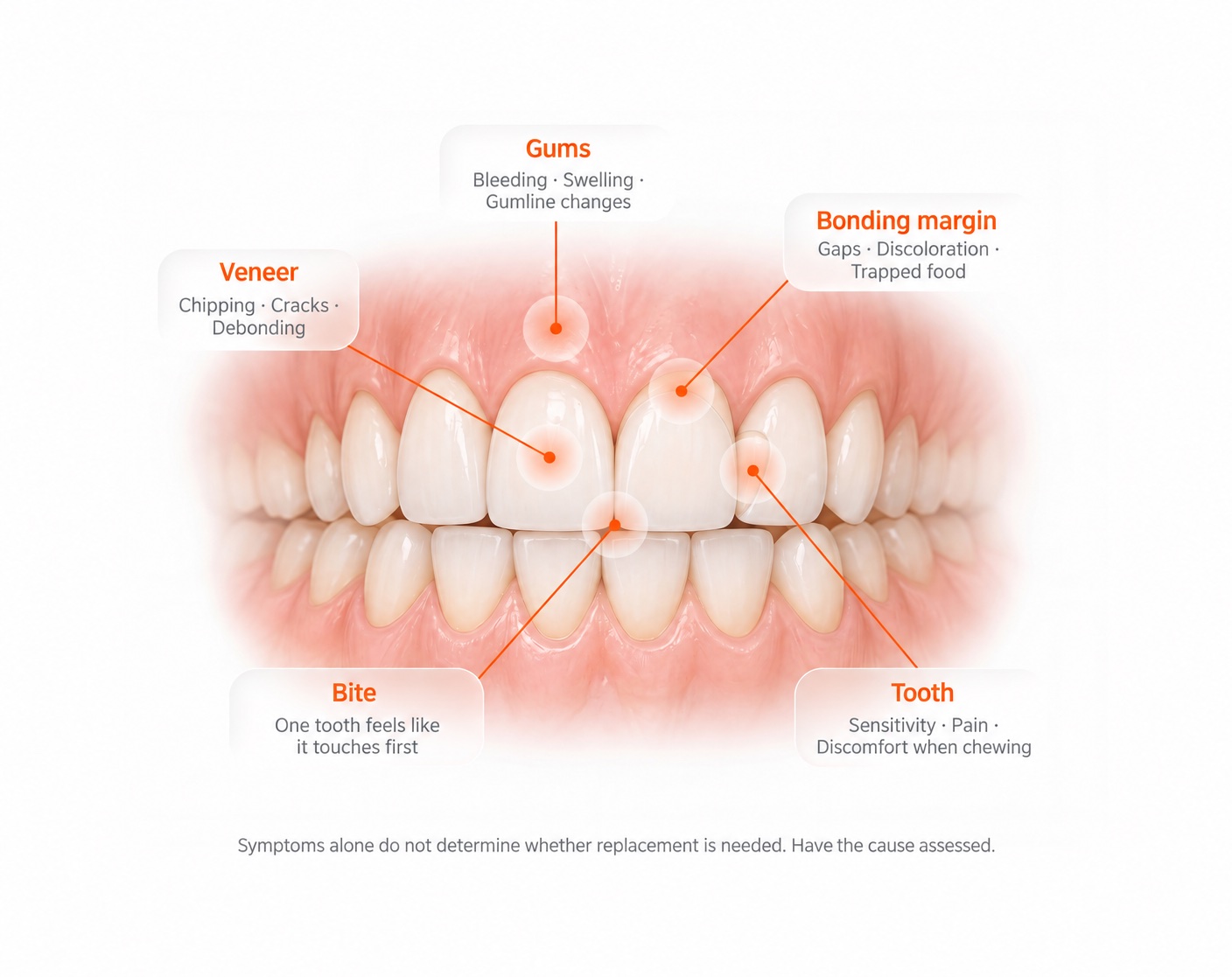
If you notice any of the following changes, refer to the right-hand column and let your dentist know. Rather than deciding on replacement yourself based on symptoms alone, the first step is to find the cause.
Area to check | Changes to watch for | When to get it checked |
|---|---|---|
Veneer | Chipping, cracks, detachment, or a loose feeling | Contact the clinic right away |
Tooth and gums | Severe pain or swelling, or damage after an impact | Contact the clinic right away |
Tooth | Sensitivity that persists or worsens, or discomfort when chewing | Book a visit soon |
Bonded margin | A margin that catches or feels open, discoloration at the margin, or food repeatedly getting stuck in the same spot | Book a visit soon |
Gums | Recurring bleeding, or gum recession exposing the margin | Book a visit soon |
Bite | A feeling that certain teeth touch first, or signs of grinding or clenching | Book a visit soon |
Appearance | Color or shape differences with surrounding teeth, or wanting to change the design | Discuss at your next regular check-up |
If a veneer comes off, don't reattach it yourself with household glue. Store the veneer where it won't break, bring it to the clinic, and avoid chewing hard foods with that tooth. Only after the bonding surface and the tooth are checked can the dentist decide whether the veneer can be bonded back on or needs to be remade. If you're wondering about the causes of symptoms like sensitivity or gum swelling, see veneer side effects by symptom and the signs that you need a visit.
Maintaining, Repairing, Replacing, or Redoing Veneers: How Are They Different?
Not every sign leads to replacement. Depending on the diagnosis, the response generally falls into one of four categories.
Response | When the condition looks like this | What happens next |
|---|---|---|
Maintain | No chipping or detachment; the bonded margin, tooth, gums, and bite are stable | Continue regular check-ups and oral care |
Repair or adjust | Damage is small and limited in extent, and bonding is stable | Consider surface smoothing, partial repair, or bite adjustment |
Replace individually | The problem is limited, such as a fracture, detachment, or margin problem on a specific tooth | Remove the veneer on that tooth and make a new one |
Redo (re-treatment) | The tooth under the veneer, decay, gums, and bite need to be re-evaluated | Treat the cause, then redesign the scope of treatment |
A problem with one tooth doesn't mean all of your veneers have to be replaced at once. On the other hand, replacing only the problem tooth may make its color look different from the surrounding veneers, so both health and aesthetics are considered when deciding the scope.
If the remaining tooth structure has become too weak to support a veneer, another restoration such as a crown may be considered. For how the two treatments differ in scope, see the difference in scope between veneers and crowns.
How Does Redoing Veneers Work?
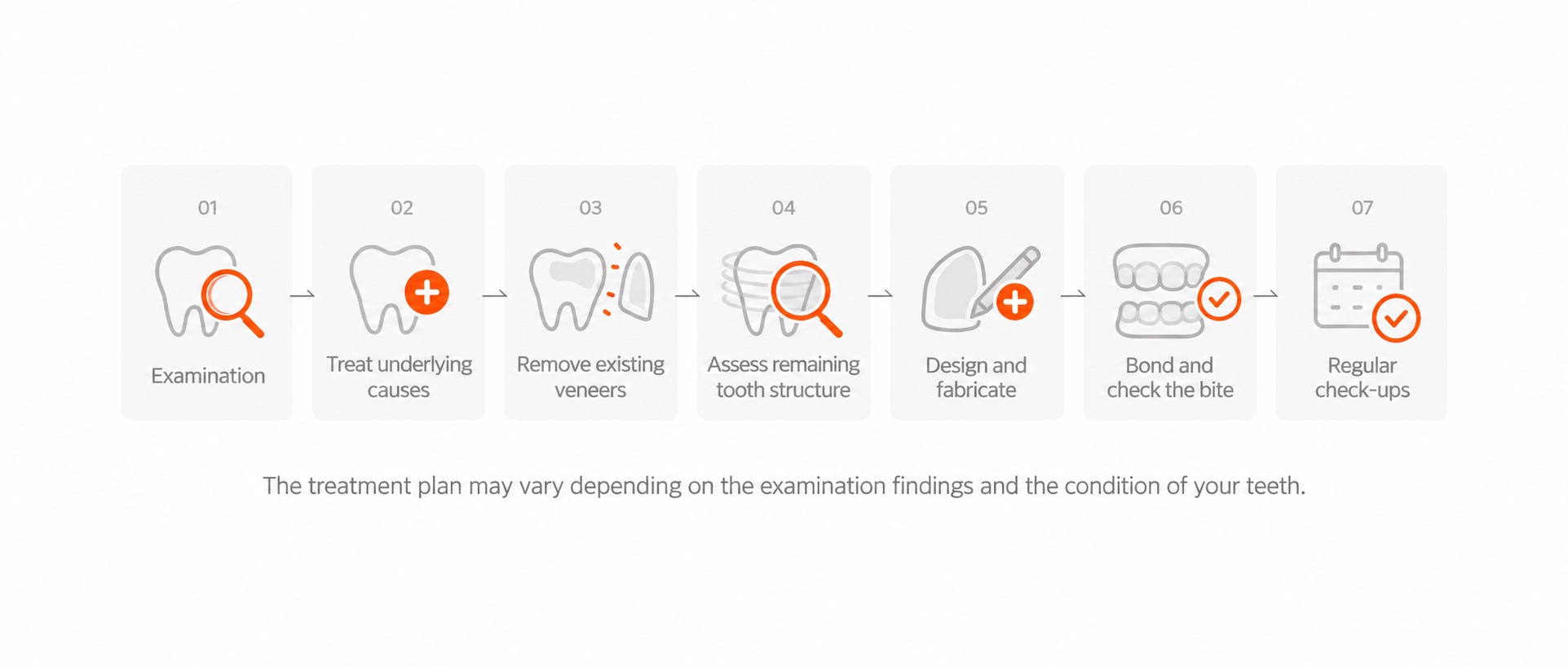
Redoing veneers starts not with making new ones but with finding out why the problem occurred. The general flow is as follows.
- Diagnosis: The existing veneers, bonded margins, underlying teeth, gums, and bite are examined, and any necessary imaging is taken.
- Treating the cause: If there is decay, gum inflammation, or a bite problem, it is treated first or a management plan is set up.
- Removing the existing veneers: The veneers are removed carefully so the underlying teeth are not further damaged.
- Evaluating the remaining tooth structure: Based on the condition of the teeth exposed after removal, the extent of reshaping and the new design are decided.
- New design and fabrication: A color, translucency, and shape that suit your face, smile, and surrounding teeth are chosen, and the veneers are fabricated.
- Bonding and bite check: After bonding, the bite is checked and adjusted where needed.
- Regular check-ups: The bonding, gums, and bite are checked to make sure the same problem doesn't recur.
The timeline, number of visits, and cost depend on how many teeth are redone, whether there are problems to treat first, and what material and fabrication method are used. The points to check when comparing quotes are summarized in why veneer prices differ and how to compare quotes.
Even when teeth have already been reduced for previous veneers, TU Dental Clinic carefully removes the existing veneers using equipment that includes lasers, then considers ZERONATE re-treatment with the aim of preserving the current tooth structure as much as possible. Minimizing further damage is the priority, and what is actually possible is decided after checking the condition of the teeth following removal.
Can Veneers Done at Another Clinic Be Replaced?
Yes. Even if it isn't the clinic that originally placed them, a dentist can diagnose their current condition and decide whether to maintain, repair, or replace them. Preparing the following information will help with your consultation.
- When the veneers were placed and how many teeth were treated
- The material used (ceramic, composite, etc.), if you know it
- Before-and-after photos
- When the discomfort started and how the symptoms have changed
It's fine if you don't have records. Your current condition can be checked with an oral exam and any necessary imaging.
6 Things to Check Before Redoing Veneers
In a re-treatment consultation, before asking "Can they be made to look good again?", you need to confirm why they need to be redone in the first place. Asking about the six points below, in order, will help you understand the scope of treatment.
1. Why Replacement Is Needed Now
Distinguish whether it's a functional problem such as chipping or detachment, a health problem such as decay or gum issues, or an aesthetic reason such as wanting to change the color or shape. The timing and scope of treatment differ depending on the reason.
- Questions to ask: What is the basis for saying replacement is needed now? What problems could occur if I don't replace them?
2. The Condition of the Existing Veneers and Bonded Margins
Check the location and depth of any damage, gaps or discoloration at the margins, and the possibility of decay at the margins. These are the criteria for deciding whether partial repair or rebonding is enough, or whether the veneers need to be removed and remade.
- Questions to ask: Can this be fixed with repair or rebonding, or do the veneers need to be remade?
3. The Remaining Natural Tooth Structure
Check how much the teeth were reshaped in the original treatment and how much tooth structure will remain for bonding once the veneers are removed. A re-treatment plan should be based not only on the shape of the new veneers but also on the teeth that will support them.
- Questions to ask: How much tooth will remain once the existing veneers are removed? Will more reshaping be needed?
4. Decay and Gum Health
If there is decay or gum inflammation, treating it may need to come before new veneers. An unstable gum line also affects the position of the margins and the final shape.
- Questions to ask: Are there any decay or gum problems that need to be treated before the veneers?
5. Bite, Grinding, and Clenching
If force concentrates on certain teeth, fracture or detachment can keep happening. Even if the veneers are remade, the same problem can come back if the cause of the concentrated force remains, so your bite and habits need to be evaluated together.
- Questions to ask: Is the fracture or detachment related to my bite or grinding? Do I need a protective appliance?
6. The New Design and Aftercare
Check whether the brightness, shade, translucency, and shape you want suit your surrounding natural teeth and your face. Also ask how you can preview the result before bonding, and about check-ups after bonding and what happens if a problem arises.
- Questions to ask: How can I check the color and shape of the new veneers before they're bonded? How do check-ups and the warranty apply after bonding?
Veneer Care: What Can You Do to Make Veneers Last?
The secret to making veneers last lies not in special products but in daily care and regular check-ups.
- Brush along the veneer margins and around the gums, and ask your dentist how to use floss or interdental brushes.
- Don't bite hard things like ice, bottle caps, or fingernails with your front teeth, and don't use your teeth as tools.
- If you suspect grinding or clenching, get evaluated at a dental clinic rather than using an over-the-counter product on your own, and if needed, ask about a custom-made protective appliance.
- After drinking beverages that stain easily, such as coffee or wine, rinse with water.
- If you notice sensitivity, pain, bleeding, swelling, lifting, or chipping, don't wait until your next check-up.
Regular check-ups are often recommended every 6 months. However, the interval may vary with risk factors such as gum condition or grinding, so work out a schedule that suits you with your dentist.
After ZERONATE placement, TU Dental Clinic checks not only the treated area but also your overall oral health, including your bite and gums, at regular check-ups every 6 months. It also runs TU CARE+, an aftercare and warranty program, and its scope and conditions are explained during consultation. For more on daily care after ZERONATE, see the ZERONATE care guide.
Getting Veneers in Korea: How Do Check-ups Work After You Return Home?
If you have veneers done in Korea and then return home, it's best to continue regular check-ups at a local dental clinic. Keeping records such as when the veneers were placed, how many teeth were treated, the material used, and the bite condition confirmed after bonding will help another clinic understand your current condition. Before you leave Korea, also confirm how to contact the clinic that treated you if a problem arises, and whether you can consult by sending photos first.
Frequently Asked Questions
Is There a Set Replacement Schedule for Veneers?
There is no fixed replacement cycle. Veneers aren't replaced just because a certain number of years has passed; instead, the current condition of the veneers, teeth, gums, bonded margins, and bite is checked before deciding whether to maintain, repair, or replace them. If there are no problems, you can simply continue with regular check-ups.
How Long Does ZERONATE Last?
ZERONATE is designed to preserve as much natural enamel as possible to create a sound bonding environment, and to reduce the factors that lead to fracture or debonding through precise design and fit. However, it isn't possible to put a specific number of years on how long one person's veneers will last. Because this depends on bite, grinding, care habits, and regular check-ups, it's important to keep having their condition checked regularly after placement.
Do Veneers Change Color?
Ceramic is a relatively color-stable material, but its color can look different over time. The approach differs depending on whether there is surface staining, discoloration at the bonded margin, or a change in the color of the surrounding natural teeth, so the cause needs to be identified first. Composite can stain more easily than ceramic.
Do Veneers Come with a Warranty?
Warranty programs and periods vary by dental clinic. Rather than checking only the period, also ask what cases are covered, what is excluded, and how a repair is distinguished from a remake. The scope of TU Dental Clinic's aftercare and warranty program (TU CARE+) is explained during consultation.
Does Redoing Veneers Mean More Tooth Reduction?
Not always. It's decided tooth by tooth, after checking the remaining tooth structure once the existing veneers are removed, whether there is decay or fracture, and the material and shape of the new veneers. If additional reshaping is needed, ask for an explanation of which area will be reshaped and why.
How Many Times Can Veneers Be Redone?
There is no set number. Whether veneers can be redone depends less on how many times it has been done and more on the remaining tooth structure and the health of the teeth and gums. That's why how much natural tooth is preserved from the very first treatment also affects your options later on.
Can a Veneer That Has Come Off Be Bonded Back On?
If the veneer and the tooth are undamaged and the bonding surface is in good condition, it can sometimes be bonded back on. However, reattaching it yourself can contaminate the space between the tooth and the veneer or leave it out of position, so store it where it won't break and have it checked at a dental clinic.
Do Veneers Need Check-ups Even If They Don't Hurt?
Yes. Small gaps at the bonded margin and changes in the gums or bite can progress without pain. At regular check-ups, have not only the appearance of your veneers but also your teeth, gums, and bite checked.
Checklist Before Your Veneer Consultation
Try to note down in advance when you got your veneers and what material was used, when the discomfort started, and the color and shape you want. In consultation, you can use the following questions.
☐ Which response is needed now: maintenance, repair, or replacement? What is that judgment based on?
☐ Where does the discomfort or damage come from? Is it related to the veneer, the underlying tooth, the gums, or the bite?
☐ How much tooth will remain once the existing veneers are removed? If more reshaping is needed, which area will be reshaped and why?
☐ Are there problems that need to be treated first? Is treatment or management needed for decay, gums, bite, or grinding?
☐ What material and design will the new veneers use? How can I check the color and shape before bonding?
☐ How do check-ups and the warranty apply after bonding? What is the check-up schedule, what are the criteria for repair versus remake, and what is excluded?
☐ What information from my previous treatment should I prepare? How is my condition checked if there are no records?
Related Articles
- What Are Veneers? Types, No-Prep Eligibility, Cost, and How ZERONATE Differs (2026)
- Laminate Veneer Side Effects: Why Sensitivity, Detachment, and Gum Issues Happen, and How to Handle Them
- Veneer Costs in Korea in 2026: Why Prices Vary and 7 Things to Check in Your Quote
- How is the ZERONATE veneers Procedure Performed: From Consultation to Completion and Aftercare
TU Dental Clinic: Treatment and Consultation
TU Dental Clinic offers cosmetic dentistry, orthodontics, dental implants, and comprehensive dental care, with a focus on preserving natural teeth. We assess the condition of your teeth and gums, your bite, and other relevant factors to develop an individual treatment plan.
- Healthcare provider: TU Dental Clinic
- Services: ZERONATE, cosmetic dentistry, orthodontics, dental implants, and comprehensive dental care
- Location: TU Dental Clinic, 12F, and TU MARTH edition, 13F, Seocho W Tower, 54 Seocho-daero 77-gil, Seocho-gu, Seoul, South Korea
Medical Information and Advertising Notice
This article is informational medical advertising provided by a healthcare institution to explain general information about consultations, examinations, treatments, and procedures. Suitability, results, recovery, and adverse effects may vary depending on individual health, the treatment area, and clinical circumstances. This article does not replace a personal diagnosis or treatment plan. Before deciding on a procedure, please consult a qualified clinician to confirm an appropriate approach and plan for your needs.