Uneven Front Teeth: What Can Dental Veneers Change About Their Length and Shape?
If one front tooth looks shorter or has a different edge shape, you may wonder whether to lengthen the shorter tooth or reshape the longer one. You may also be wondering whether treating just one tooth can give a natural match with the tooth beside it.
Veneers can help address differences in the tooth itself, such as its length, edge shape, or color. But if the main cause is how much of the tooth the gum covers or the tooth’s position, veneers alone cannot change that underlying cause. That is why teeth that appear to have the same “length difference” may need different approaches.
This article explains how to describe the differences you see, what veneers can change, and what may require another type of dental care. It also looks at what needs to be matched when treating just one tooth so that it blends naturally with its neighbor.
What looks different about your front teeth?
Start by looking in a mirror or at everyday photos. Is the difference at the biting edges, along the gumline, or in the position of the teeth? This is a way to explain your concerns at your appointment, rather than a way to diagnose the cause yourself.
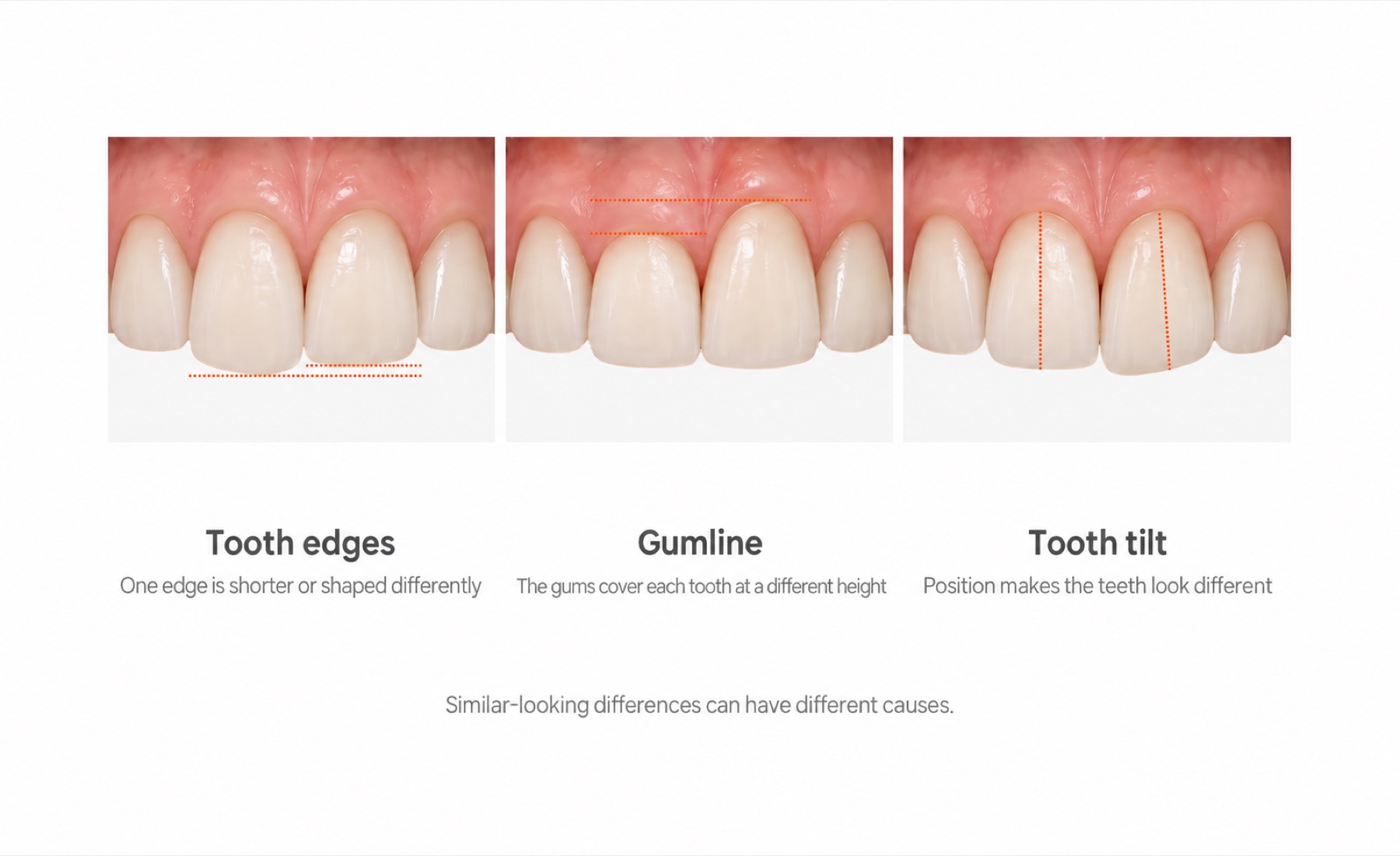
| Category | Description |
|---|---|
| Tooth edges | One edge is shorter or shaped differently |
| Gumline | The gums cover each tooth at a different height |
| Tooth tilt | Position makes the teeth look different |
Similar-looking differences can have different causes.
What you notice | Possible reasons for the difference | What to check at the appointment |
|---|---|---|
One front tooth’s edge looks shorter or chipped | The original edge shapes may differ, or the edge may have worn down or chipped later | Remaining tooth structure, wear or chipping, and the bite |
The teeth meet the gums at different heights | The gums may cover different amounts of each tooth | Gum condition and the actual length of each tooth |
One tooth looks tilted or sits further forward or back | Position can make teeth of the same length look different | Alignment, tilt, and how the upper and lower teeth meet |
For example, if a tooth has become shorter because its edge has worn down, a dentist can assess whether to build up the missing shape. If a tooth looks shorter because the gumlines differ, adding material to its edge will not remove the difference at the gumline. A tilted tooth may also look different in width and length from the front. Several factors can occur together, so a single row in the table is not enough to choose a treatment.
Let your dentist know whether the difference has always been there or whether one edge has chipped or become shorter recently. Older photos and your treatment history can help explain the change. If recent chipping or wear comes with discomfort when chewing, both the condition of the tooth and your bite need to be checked, as well as its appearance.
What can dental veneers change?
A veneer is a thin layer of material bonded to the front of a tooth to adjust its visible length, edge contour, width, and color. If the tooth itself is short or its edge is uneven, building up its shape may be considered when the tooth’s condition and the available space allow the intended change. If one tooth differs in color, its shade and translucency are also planned to blend with the neighboring natural tooth. The American Dental Association’s explanation of veneers also describes their use for chipped teeth and differences in shape and color.
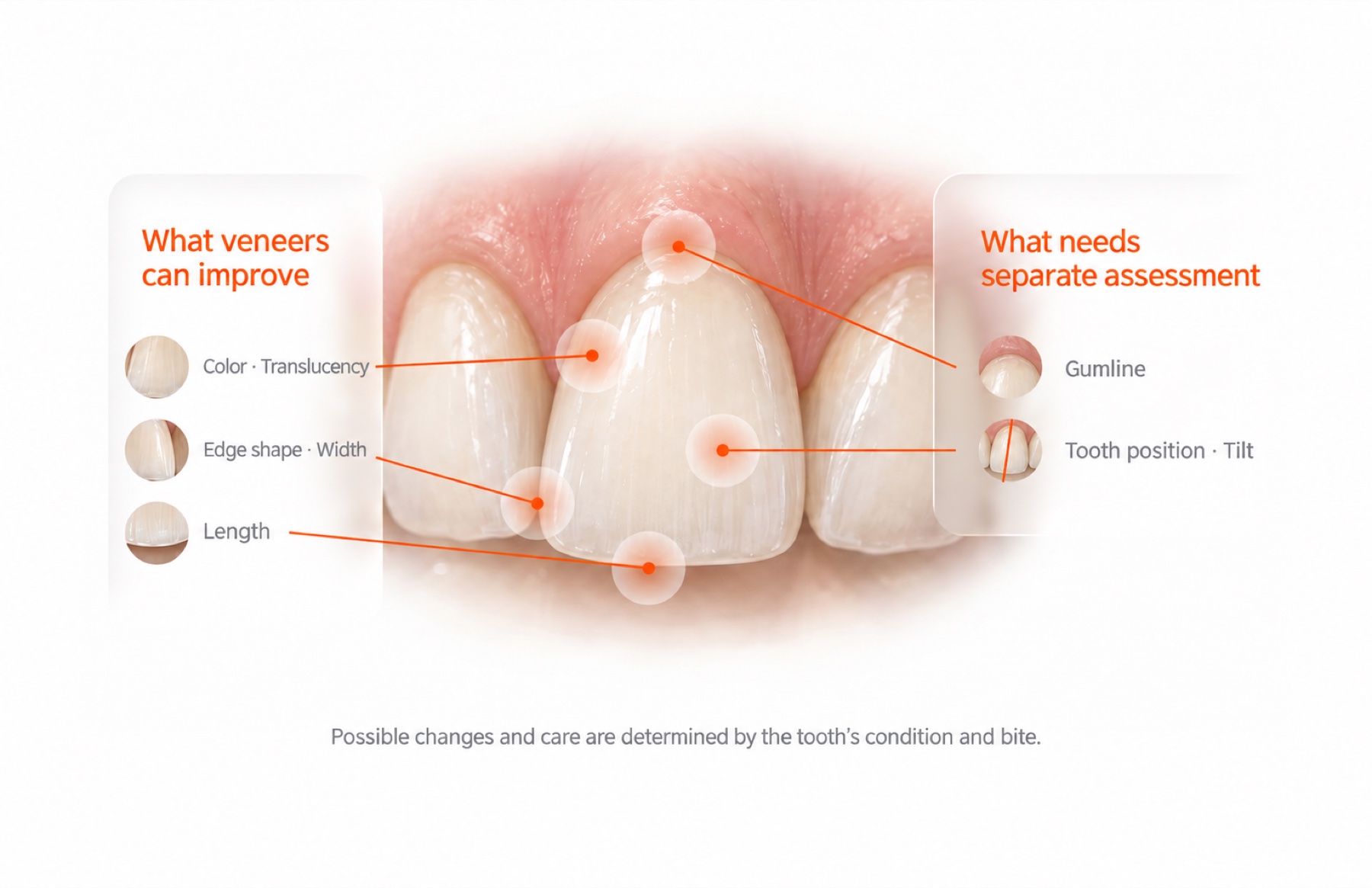
What veneers can improve
- Color · Translucency
- Edge shape · Width
- Length
What needs separate assessment
- Gumline
- Tooth position · Tilt
Possible changes and care are determined by the tooth's condition and bite.
How do you decide whether to lengthen the shorter tooth or reshape the longer one?
Lengthening is not the only option when one front tooth is slightly shorter. Depending on the existing tooth and the change you want, your dentist may consider composite bonding to build up the necessary area or a veneer. If you are considering reshaping the longer tooth, the enamel, the tooth’s proportions after reshaping, and your bite need to be assessed first. Adding to a shorter tooth and reducing a longer one involve different changes to the tooth. Neither can be assumed to be more conservative or more natural-looking in every case.
Even with a similar length difference, the plan may change if there is not enough space to add material or if the upper and lower teeth would contact the extended area heavily. A history of grinding, clenching, or repeated chipping also matters. Grinding, clenching, and a deep bite are factors to consider when assessing suitability for veneers. A photo alone cannot establish how many millimeters a tooth can be lengthened or reduced; that requires an examination of the teeth and bite.
If you are concerned about how much tooth structure may need to be removed, ask whether preserving natural teeth is a guiding principle of the treatment plan. ZERONATE is TU Dental Clinic’s premium dental veneer brand, embodying its philosophy of preserving natural teeth. With a thickness approaching zero, it preserves natural teeth and realizes the health and beauty of ideal natural teeth. This definition does not mean that every tooth can be treated without preparation. Whether preparation is needed, and which areas need to be reduced and by how much, are decided after assessing the tooth’s condition, the intended change, and the bite.
What is difficult to change with veneers alone?
Bonding a veneer does not move the gumline or reposition a tooth. If the gumline contributes to the apparent length difference, the gums need to be examined to decide whether gum-related care is needed. If one tooth is rotated or sits noticeably further forward or back, orthodontic treatment may be considered to adjust its position. It helps to distinguish what each approach actually changes, rather than trying to achieve every desired change with one treatment.
Veneers can improve the visible shape and color of teeth, but they do not address every gumline or tooth-position difference, or every underlying cause of wear contributing to asymmetry. Depending on your condition, composite bonding, tooth reshaping, orthodontics, or gum-related care may be discussed individually or in combination. Before choosing, ask which changes are achievable and which differences may remain.
Can treating just one tooth look natural?
Treating just one front tooth can be an option. However, a natural appearance depends on more than bringing the two biting edges to the same level. The length, width, and edge shape visible when you smile, the gumline, and the color of the neighboring tooth all need to be considered.
Lengthening a short tooth changes its length-to-width ratio. It is important to check whether one tooth looks too long or too wide and whether the roundness of its edge fits with the neighboring tooth. Color matching also involves more than equal brightness. Natural teeth vary in shade and translucency at their edges, so the color of a single treated tooth is assessed alongside its neighbor.
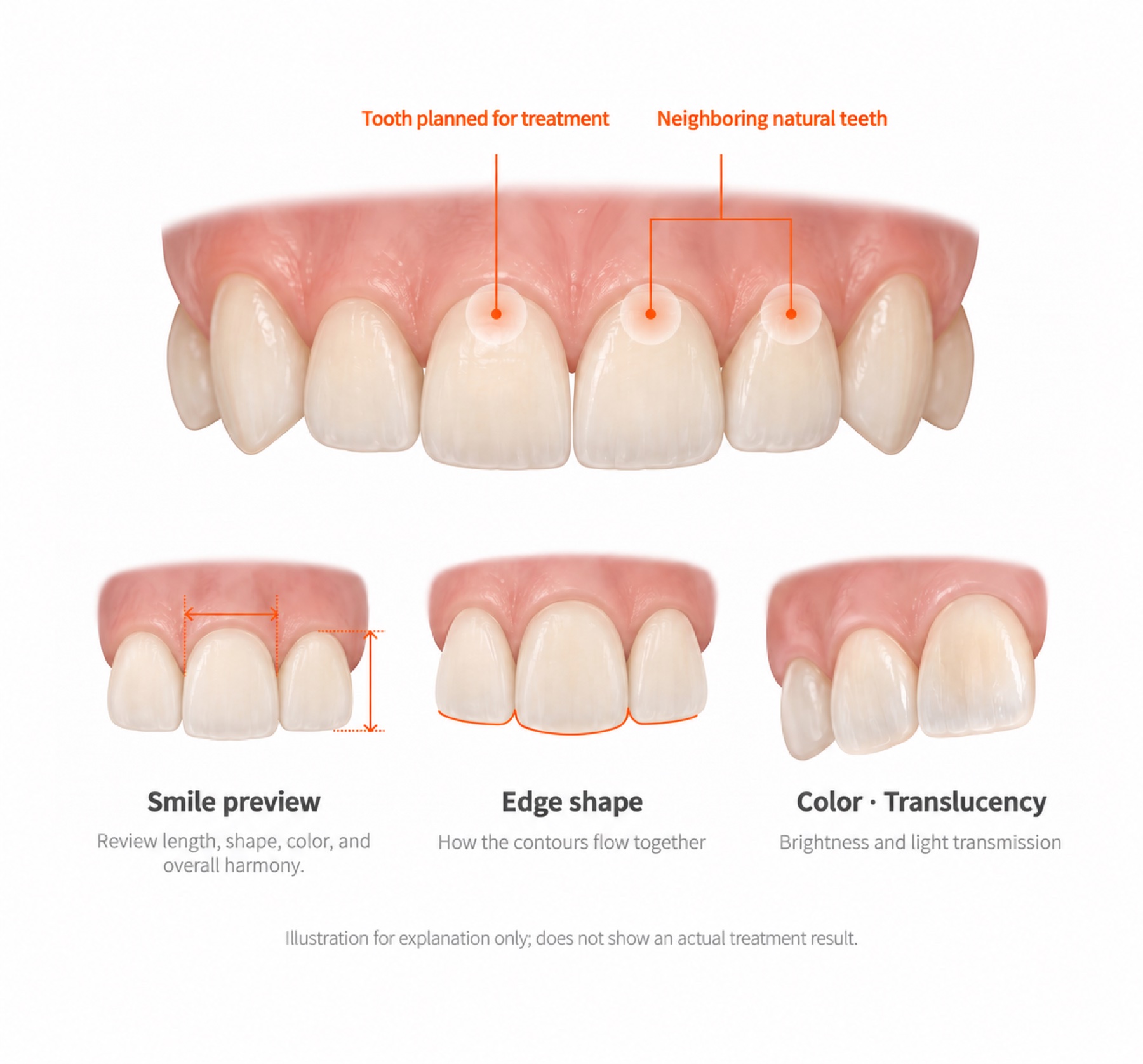
- Tooth planned for treatment
- Central incisor indicated for procedure.
- Neighboring natural teeth
- Adjacent teeth used for matching and harmony.
| Category | Description |
|---|---|
| Smile preview | Review length, shape, color, and overall harmony. |
| Edge shape | How the contours flow together |
| Color · Translucency | Brightness and light transmission |
Illustration for explanation only; does not show an actual treatment result.
In TU Dental Clinic’s ZERONATE treatment process, smile design and a preview are used to review tooth shape, proportions, and overall harmony in advance. A shade guide is compared with the natural teeth to select the color. Before final bonding, the completed restoration is tried on the actual tooth to check its fit, color, and bite. If you want to know how one front tooth will blend with its neighbor, share your feedback during the preview and ask how the actual color and bite will be checked before final bonding. A preview cannot guarantee an individual’s final result.
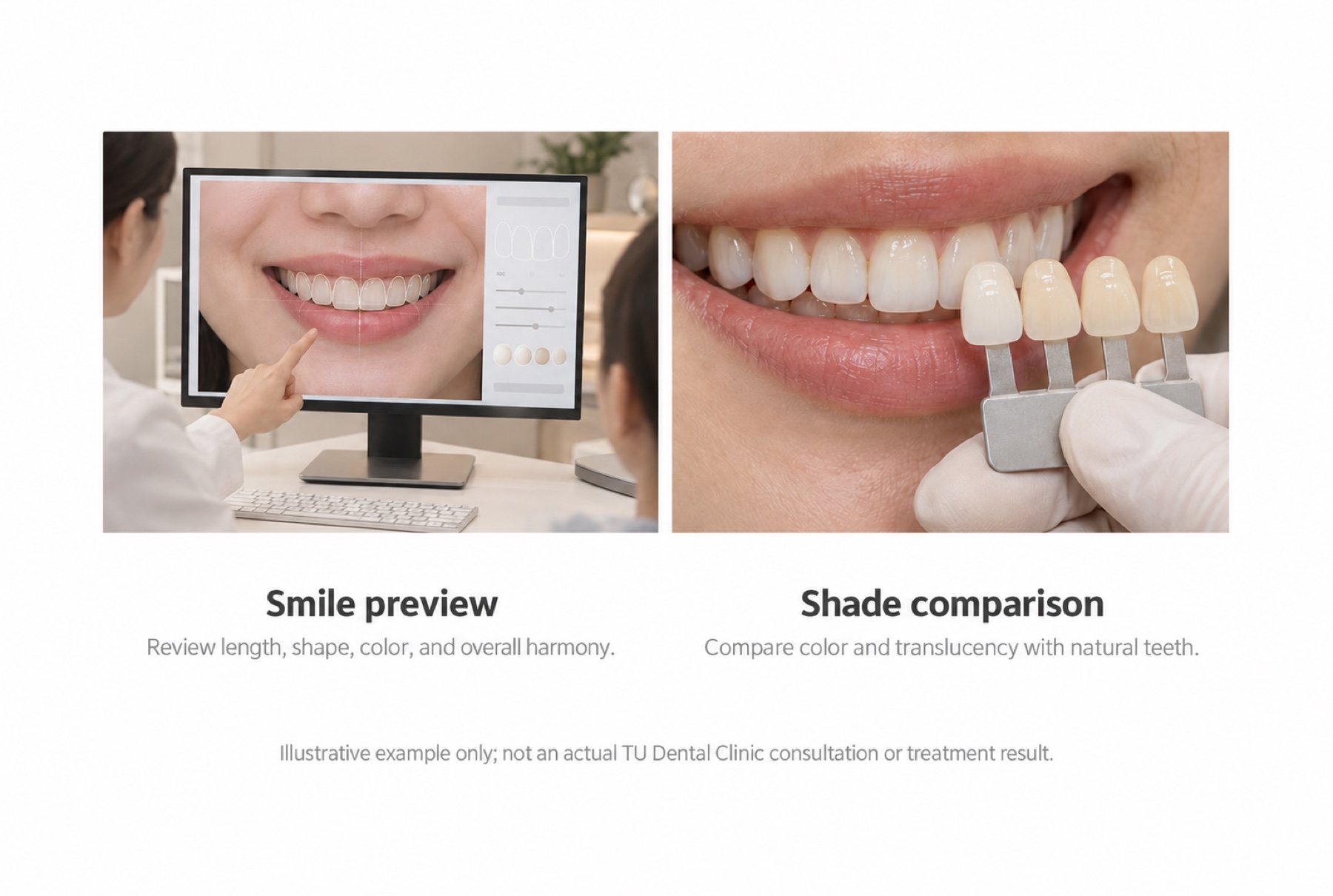
| Title | Description |
|---|---|
| Smile preview | Review length, shape, color, and overall harmony. |
| Shade comparison | Compare color and translucency with natural teeth. |
Illustrative example only; not an actual TU Dental Clinic consultation or treatment result.
If your goal is to change the length or shape of the tooth itself, and you value both preserving natural teeth and matching the neighboring tooth, you can also explore ZERONATE’s treatment approach and scope. If the gumline or tooth position is the main cause, care that addresses those areas may be needed first or alongside other treatment.
Frequently asked questions
Could I just have the longer front tooth reshaped a little?
The answer depends on whether the tooth is actually longer or simply looks longer because of its gumline or position. After checking the enamel in the area to be reshaped, your bite, and the tooth’s proportions afterward, your dentist can compare this with building up the shorter tooth. The amount to remove is not decided in advance solely to make the two teeth look equal.
Can I get a veneer on just one front tooth?
A plan involving just one tooth can be considered. The number of teeth and extent of treatment are decided by assessing how the length, width, edge shape, and color will blend with the neighboring tooth, what shows when you smile, and your bite. It is not possible to promise in advance that one tooth will be enough or to assume that several teeth must be treated.
Will a single treated tooth look different in color from the tooth beside it?
The color is planned by comparing the shade, brightness, and translucency of the neighboring natural tooth. Because each natural tooth transmits light differently, an exact visual match cannot be promised. Ask what will be checked during the design preview and what will be checked when the restoration is tried on the tooth before final bonding.
Does teeth grinding mean a short front tooth cannot be lengthened?
Grinding alone does not determine whether lengthening is possible. However, the history of wear or chipping, your bite, and the forces on the teeth need to be assessed first. The findings may change how much length can be added, which method is suitable, and the care plan afterward.
A checklist for your consultation
It is enough to note when you first noticed the difference, whether there has been chipping, wear, or discomfort when chewing, and what you would like to change. You can also bring older photos or your treatment history if available.
☐ Is the main reason my front teeth look different their edges, gumlines, or positions?
☐ Which parts can veneers change, and which would need another approach?
☐ If just one tooth is treated, when and how will its shape and color be compared with the neighboring tooth?
☐ Will grinding or my bite affect the extent of treatment or the care needed afterward?
Related reading
For more about ZERONATE’s treatment approach and how the gumline affects the appearance of front teeth, see the following articles.
TU Dental Clinic: Treatment and Consultation
At TU Dental Clinic, we focus on preserving natural teeth while providing aesthetic dental treatment, orthodontics, dental implants, and comprehensive dental care. We assess your teeth, gums, and bite to guide an individual treatment plan.
Provider: TU Dental Clinic
Main services: ZERONATE, aesthetic dental treatment, orthodontics, dental implants, and comprehensive dental care
Address: Seocho W Tower, 54 Seocho-daero 77-gil, Seocho-gu, Seoul, South Korea — 12F: TU Dental Clinic; 13F: TU MARTH edition
Medical Information and Advertising Notice
This article is informational medical advertising provided by a healthcare institution to explain general information about consultations, examinations, treatments, and procedures. Suitability, results, recovery, and adverse effects may vary depending on individual health, the treatment area, and clinical circumstances. This article does not replace a personal diagnosis or treatment plan. Before deciding on a procedure, please consult a qualified clinician to confirm an appropriate approach and plan for your needs.